


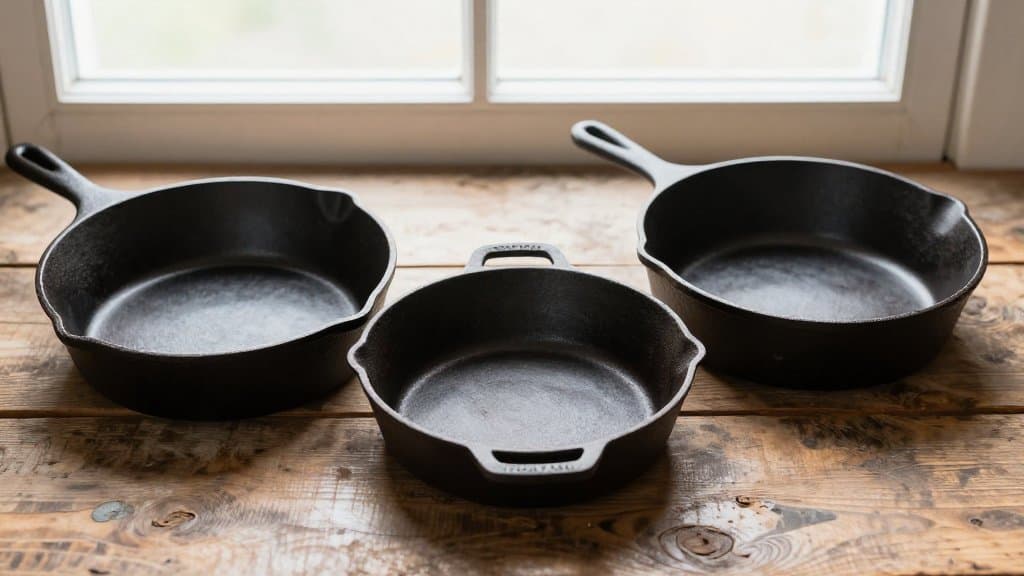
Flip a heavy skillet over at the thrift store and the base becomes a fingerprint. A rough seam, a spelled out logo, or a single raised number can move a vintage cast iron skillet from a 6 dollar shelf pan to a piece worth hundreds. Learning to read gatemark cast iron and maker logos is the fastest edge a reseller can build, because most shoppers walk right past the good stuff.
This guide covers the marks that matter, from pre 1890 gate marks to Griswold and Wagner logos, plus the size numbers and heat rings that date a pan within a decade. Every price here comes from recent sold listings and collector references, so you can read a base and know roughly what an antique cast iron skillet should fetch. If you already flip vintage Pyrex patterns, cast iron rewards the same habit of turning every piece over.
What Gatemark Cast Iron Tells You
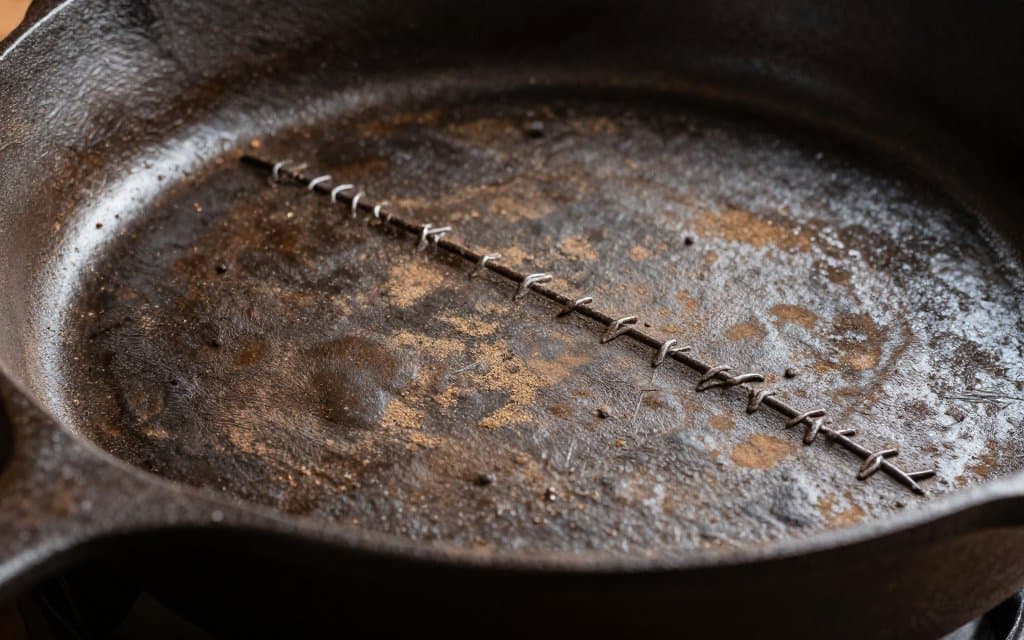
A gate mark is a raised, slightly rough line or scar running across the bottom of a pan. It is the leftover scar from the sprue, the channel that molten iron flowed through in a sand mold. Foundries poured iron this way until roughly the 1880s, so the mark is a reliable sign that a piece predates most brand logos.
Because the mark comes from the casting process itself, gatemark cast iron cannot be faked cheaply. Run a finger across the base. A genuine gate mark feels gritty and stands proud of the surface, while a modern reproduction has a smooth, machine ground bottom. That one detail separates a true antique from a lookalike.
A true gate mark cannot be faked cheaply, which is why collectors treat that rough seam as proof a pan was cast before about 1890.
- •A raised, rough seam across the pan bottom
- •Casting that usually predates about 1890
- •No maker logo on most gate marked pieces
- •A sandy texture that feels slightly gritty
- •Often a domed or wobbly sitting surface
How a Gate Mark Looks and Feels
Hold the pan at a low angle under a light. The gate mark shows as a straight or slightly curved ridge, often near the center of the base, and it catches your fingernail. Later factory pans replaced this with a smooth ground surface, so the presence of the ridge alone pushes a find into true antique territory.
Why Pre-1890 Pieces Command a Premium
Fewer early pans survived, so scarcity drives the price. A plain gate marked skillet in clean shape can still bring 40 to 100 dollars, and rare early branded pieces climb far higher. The oldest Erie and spider marked Griswold pans are among the most sought pieces in the hobby, with fewer than 100 of some sizes believed to exist.
Reading Griswold Logos by Era
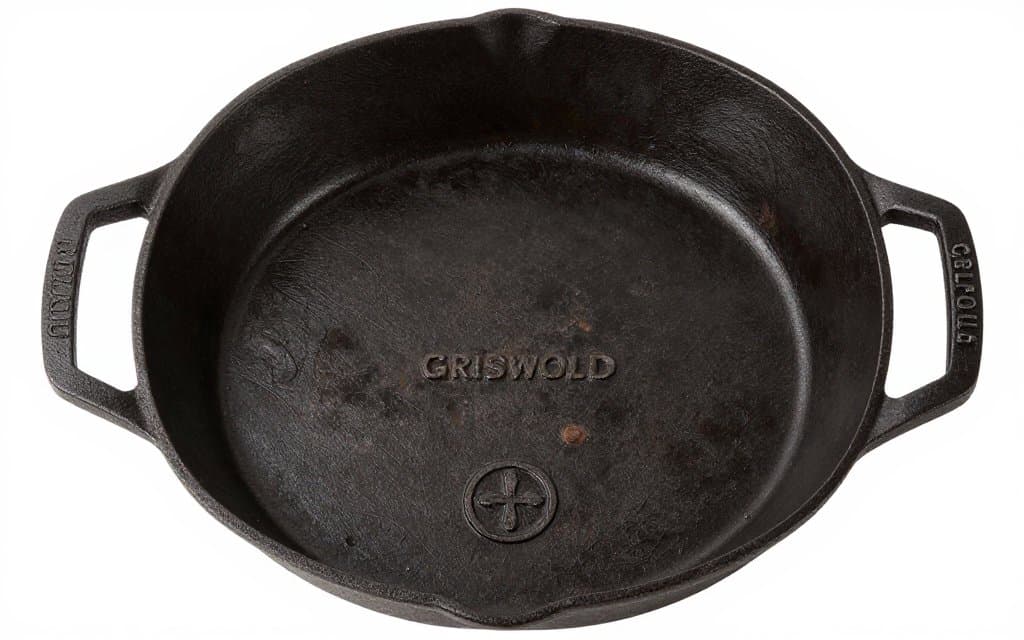
Griswold of Erie, Pennsylvania stamped six main logos across nearly a century, and each one pins a pan to a window of years. The company began with a rare spider mark, moved to an Erie oval, then to the cross in circle block logos most collectors know. Matching the mark to a dated Griswold logo timeline is the core of cast iron skillet identification.
| Logo | Years | Rarity |
|---|---|---|
| Spider cross | 1865 to 1880 | Extremely rare |
| Erie oval | 1880 to 1905 | Scarce |
| Large block | 1905 to 1930 | Common |
| Small block | 1930 to 1940 | Common |
| Slant EPU | 1957 to 1969 | Common |
Slant Logo Versus Block Logo
The large block logo, with GRISWOLD set inside a cross and circle, ran from about 1905 to 1930. The slant logo, in italic script, came later, from 1957 to 1969, after Griswold and Wagner came under the same owner. A crisp large block No. 8 in clean shape is the workhorse flip, while an early slant with a front pour spout can jump into the hundreds.
Condition drives griswold cast iron value as much as the logo. A No. 8 large block in excellent shape brings 50 to 180 dollars, a No. 12 climbs to 200 to 600 dollars, and an industrial No. 20 can pass 2,500 dollars. Cracks, deep pitting, or a warped base cut those numbers hard.
A Griswold No. 13 with a spider heat ring and Erie logo can bring close to 2,000 dollars, and a rare 1940s No. 13 once sold for a record 20,000 dollars at auction.
Wagner Ware Sidney Marks and Dates
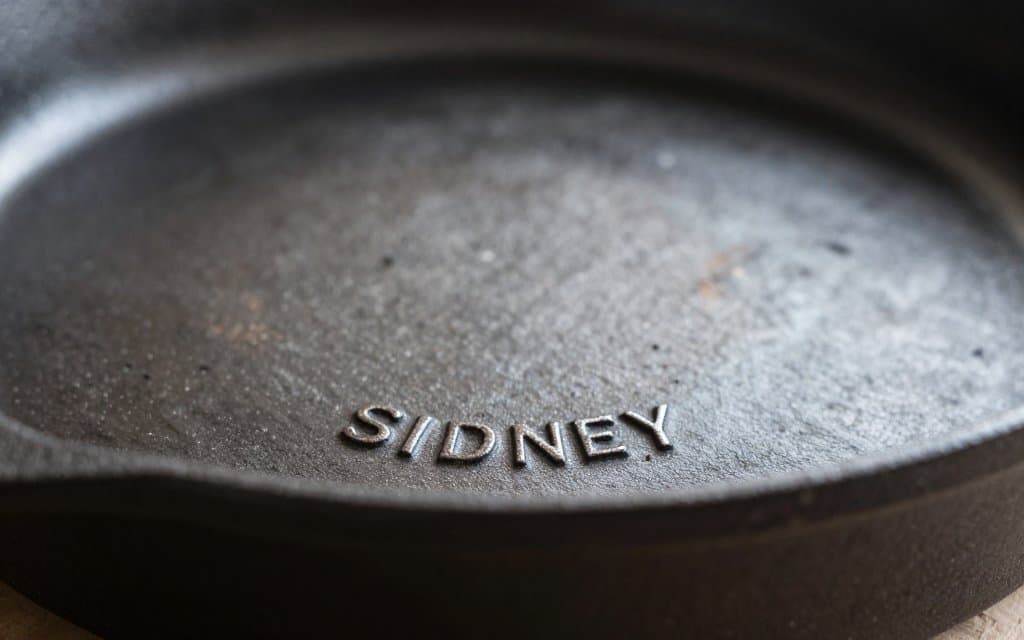
Wagner built its foundry in Sidney, Ohio and gave Griswold real competition in the collector market. The most common mark, wagner ware sidney O in a stylized arc, ran from about 1920 to 1959. Earlier straight block Wagner cast iron dates to the 1890s through 1915, so the exact lettering narrows the age quickly.
Turn a suspected Wagner over and look for the letter O set between Sidney and the period, a nod to Ohio. A clean wagner cast iron skillet in a No. 8 with the Sidney O mark is a steady seller, and the smoother, lighter body compared to Griswold makes these popular with cooks as well as collectors. Well kept examples have even been listed near 5,000 dollars.
- •Straight block Wagner runs 1890s to 1915
- •Wagner Ware Sidney O spans about 1920 to 1959
- •Heat rings vanish on most pans after 1935
- •National was Wagner's budget line into the 1940s
Weigh a No. 8 skillet. A genuine Griswold lands between 4.5 and 5 pounds, so a feather light pan is a red flag.
Size Numbers, Heat Rings, and Pattern Codes
The big number on the base is a size number, and it does not mean inches. It matches the eye opening on an old wood burning stove. A No. 8 measures close to 10.5 inches across the top and a No. 3 is a small egg pan, so the number is a size code, not a diameter. Collector references like the Cast Iron Collector catalog how those size and pattern numbers decode.
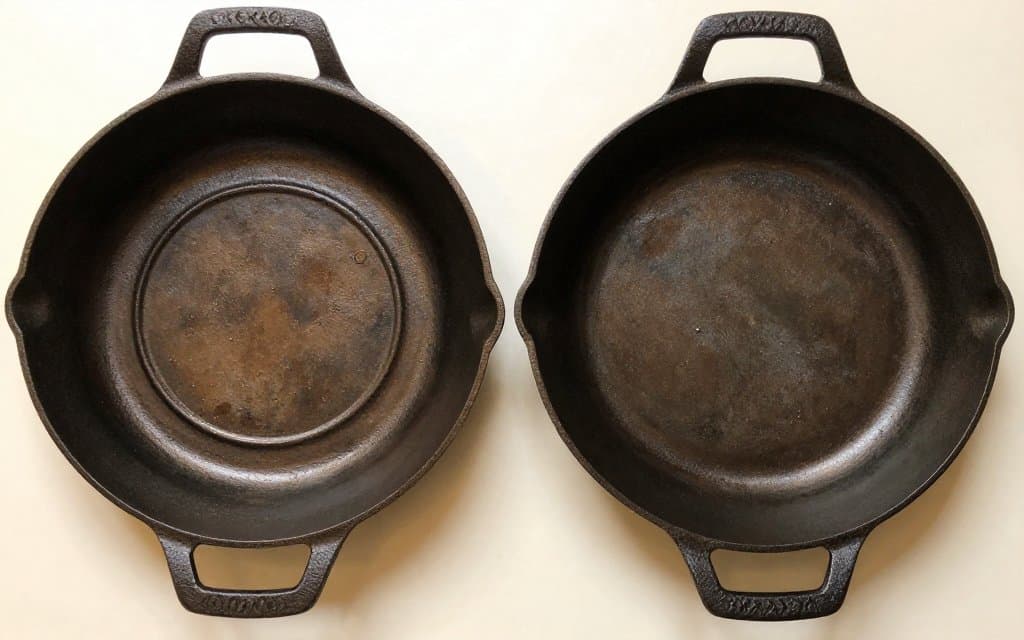
Heat rings, the raised circular ridge on the bottom, sealed the pan against a stove eye and help with dating. Most vintage cast iron cookware made before about 1935 has a heat ring, while later antique cast iron pans have a flat, smooth base. Four digit numbers are Wagner pattern codes, and single raised letters are molder's marks left by individual foundry workers. The same label logic dates other categories, from how you date vintage lighting by its label to kitchenware.
- •Size number matches a stove eye, not inches
- •A No. 8 runs about 10.5 inches across the top
- •Four digit codes are Wagner pattern numbers
- •Single raised letters are molder's marks
- •Inch dimensions point to the 1950s or later
What Vintage Cast Iron Is Worth Now
Prices swing with brand, size, and condition, but the pattern holds. Common Griswold and Wagner No. 8 pans move in the tens of dollars, while unusual sizes and rare logos move in the hundreds or thousands. The table below uses recent collector references and sold listings for antique cast iron frying pan values. Cast iron also turns up constantly in the Goodwill outlet bins, where pans sell by the pound.
| Piece | Logo era | Value |
|---|---|---|
| Griswold No. 8 | Large block | $50 to $180 |
| Griswold No. 6 | Large block | $30 to $80 |
| Griswold No. 12 | Large block | $200 to $600 |
| Griswold No. 20 | Industrial | $800 to $2,500 |
| Wagner No. 8 | Sidney O | $40 to $60 |
| Griswold No. 13 | Spider Erie | Near $2,000 |
Odd sizes drive the surprises. A No. 8 is the most common size ever made, so it stays affordable, while a No. 1, No. 2, or a giant No. 14 is scarce and priced to match. Vintage cast iron pans in those rare sizes are the ones worth pulling off the shelf for a second look and a base check.
Spotting Fakes and Reproductions
Reproductions of famous logos exist, so a few checks protect your money. Shine a low angle flashlight across the mark. Genuine lettering is crisp and even, while a recast copy looks soft, blurry, or slightly off center. A gritty cooking surface is another warning, since old factory pans were machined nearly as smooth as stainless steel.
- •Blurry or off center lettering under a flashlight
- •A gritty surface instead of a machined one
- •Made in China or Taiwan cast into the base
- •A No. 8 that weighs well under 4.5 pounds
Frequently Asked Questions
How can I tell how old my cast iron skillet is?
Start with the logo, then confirm with construction details. A gate mark points to before 1890, a heat ring usually means before 1935, and a dimension stamped in inches points to the 1950s or later. Layering these clues on top of the maker logo dates most pans within a decade.
What is the most valuable vintage cast iron brand?
Griswold and Wagner lead the American market, with Griswold usually topping the price charts. Rare Griswold pieces like a spider Erie No. 13 have brought close to 2,000 dollars, and a record 1940s example reached 20,000 dollars, while everyday Wagner No. 8 pans stay near 40 to 60 dollars.
Is unmarked cast iron worth anything?
Yes, unmarked pans can still sell, especially quality unmarked Wagner and Griswold blanks that never received a logo. Look for a smooth machined surface, a heat ring, and a clean No. 8 or No. 10 size. These often move for 20 to 40 dollars to cooks who want a vintage pan without the collector premium.
Ready to stop guessing at flea market tables and start pricing pans with real data? Snap a photo with Thrift Scanner and let AI identify the maker, read the marks, and show live resale value before you buy. Get the app here: iOS or Android.