


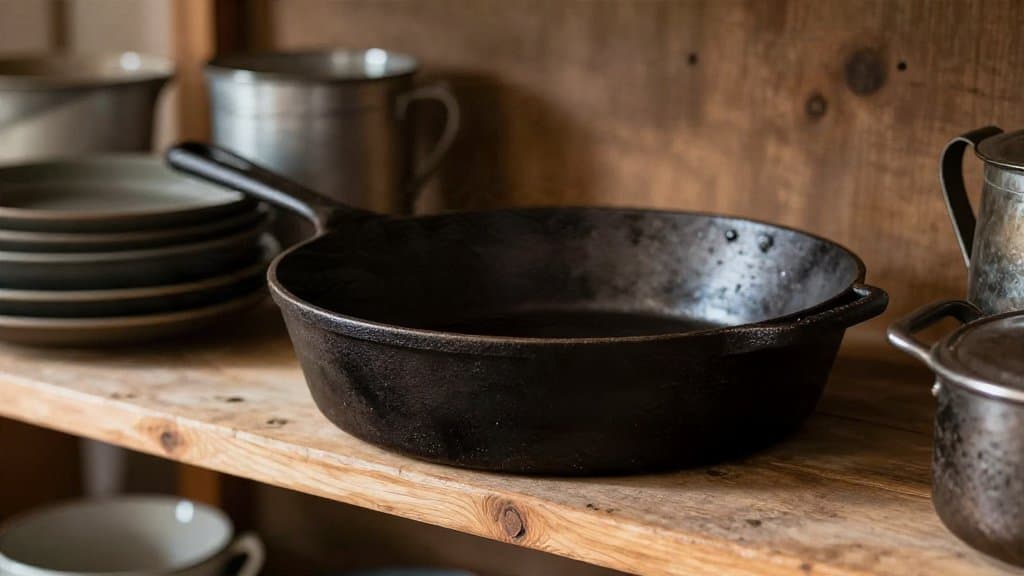
A #13 Griswold skillet with a slant logo and the word ERIE under it brings $2,000 to $3,000 from collectors. A Griswold pan made after 1957 can look almost identical on the stovetop and still sell like any other used skillet. The gap comes down to the Griswold cast iron logo on the bottom and the few words cast around it.
Thrift stores rarely price old iron by its markings. Most of it lands on the same shelf as dented aluminum sauté pans, and that's where a careful flipper wins. If you can read a pan's bottom in about ten seconds, you'll know whether it's a vintage cast iron skillet worth listing or a solid cooker to leave for someone's kitchen.
How to read the Griswold cast iron logo on the bottom
Griswold registered its cross-in-a-circle trademark with the US Patent Office in 1909, according to the Griswold & Wagner collector FAQ. The cross didn't stay the same, though. Lettering style, logo size and the text underneath changed over the decades, and each change gives you a rough date.
Slant logo, 1906 to 1929
The slant logo puts GRISWOLD in italic letters across the arms of a cross inside a double circle. The Cast Iron Collector trademark history lists variants marked ERIE and ERIE, PA, U.S.A., often shortened by collectors to EPU. Most slant pieces have a raised heat ring, and smooth-bottom slants are rare.
Large block logo, about 1920 to 1940
Around 1920 the lettering turned bold and upright. Large block skillets usually add CAST IRON SKILLET and ERIE, PA, U.S.A. to the bottom, and you'll find them with and without a heat ring. It's the mark you'll see on many of the pricier listings.
Small block logo, from about 1939
About 1939 the logo shrank and the lettering got lighter. CAST IRON SKILLET disappeared and the address became plain ERIE, PA. A brief medium block version showed up around 1955. These pans cook just as well, but they usually sell for less than the same size in large block.
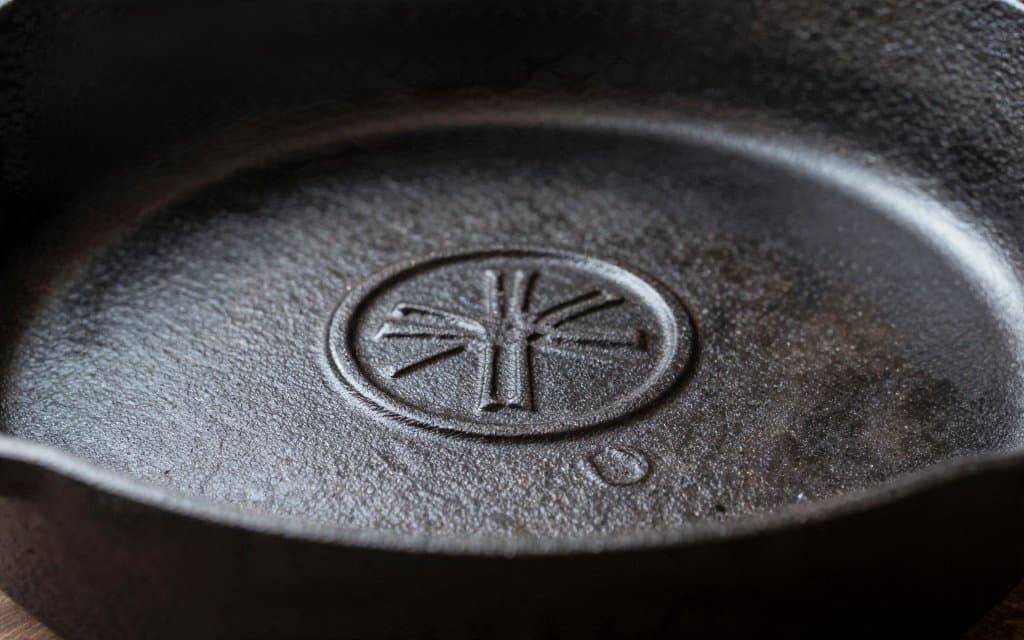
| Logo | Rough dates | Bottom clue |
|---|---|---|
| Slant logo | 1906 to 1929 | Italic GRISWOLD, ERIE or ERIE, PA, U.S.A. |
| Large block | About 1920 to 1940 | Bold letters plus CAST IRON SKILLET |
| Small block | About 1939 to 1957 | Smaller logo, address reads ERIE, PA. |
| Sidney era | 1958 to 1973 | No Erie, Made in USA, size in inches |
Why the word Erie matters more than the Griswold logo
Griswold's Erie foundry stopped production in December 1957. McGraw Edison bought the company on March 29, 1957 and sold it that December to Randall Corp., which had owned Wagner since November 1952. After that, pans carrying the Griswold name came out of the Wagner foundry in Sidney, Ohio, and they don't say Erie.
The same FAQ notes that post-1957 pieces usually list the size in inches instead of a trade number and carry Made in USA on the bottom. Most collectors don't count Sidney-made pans as real Griswold, so a Griswold logo without Erie is mostly a cooking pan, not a collectible.
No Erie, no collector premium. If the bottom says Made in USA and gives the size in inches, it was made in Sidney, Ohio after 1957.
What about dual Griswold and Wagner marks?
Some later pans carry both trademarks on the bottom. The collector FAQ dates many of these to the late 1970s or early 1980s, long after Erie closed. They're usable kitchen pans, and that's how they price. Treat a dual mark the way you'd treat modern Wagner cast iron, not as a find.
- •Look for ERIE or ERIE, PA, U.S.A. near the cross logo
- •Check for a raised heat ring around the edge of the bottom
- •Read the size number, since big and tiny sizes pay more
- •Ignore pattern letters after the number when pricing
- •Pass on pans marked in inches with Made in USA
Griswold cast iron value by size and mark
Size and mark work together. A roundup of high-value vintage cast iron published on AOL puts a #2 large block EPU skillet with heat ring at $700 to $1,000, while a #14 large block EPU with heat ring lands around $600 to $800. Very small and very large sizes tend to pull more than the everyday #8.
| Piece | Mark | Typical value |
|---|---|---|
| #13 skillet | Slant logo, ERIE | $2,000 to $3,000 |
| #2 skillet | Large block, EPU, heat ring | $700 to $1,000 |
| #14 skillet | Large block, EPU, heat ring | $600 to $800 |
| #20 hotel skillet | Large block, ERIE PA. | $800 to $1,800 |
| #12 skillet cover | Low dome, fully marked | $300 to $475 |
| Spider skillet | ERIE with spider web | Around $10,000 |
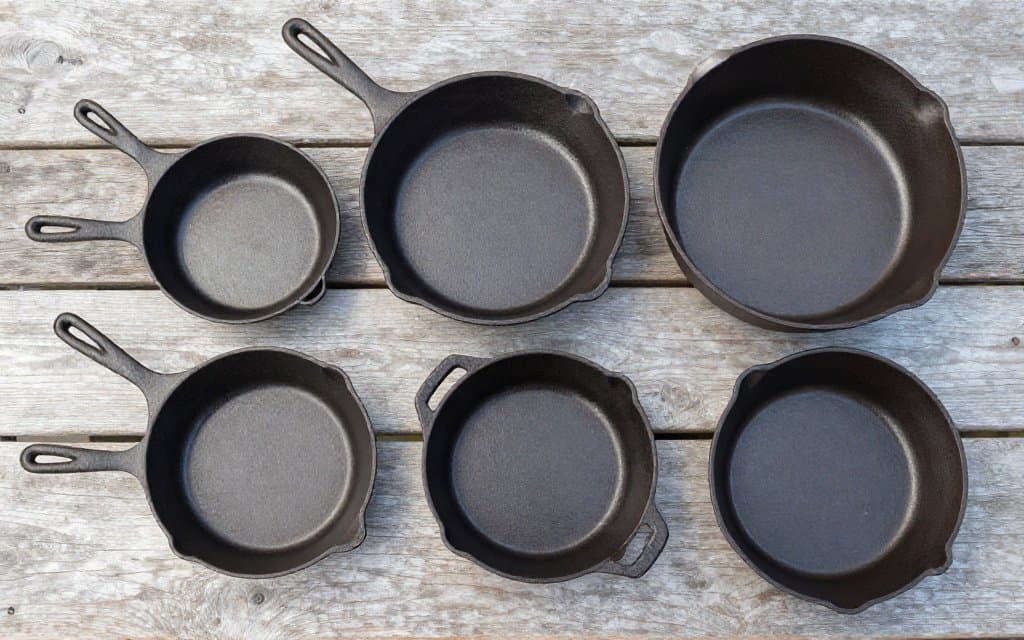
Real sales back those ranges up. The value guide at Griswold Cookware shows a #20 hotel skillet that sold at auction for $1,550, and the same roundup warns that post-1957 pans stamped 20 inch skillet are worth far less. The famous Erie spider skillet, made around 1890 to 1891 with a spider web cast into the base, can reach about $10,000 in top shape.
A Griswold Tite-Top Dutch oven with a matching fully marked lid can bring $1,000 to $1,400 in larger sizes. Sold alone, lids rarely clear $75 to $100.
What a thrift store Griswold skillet means for your profit
Here's the honest picture. The #8 is the common size, and Griswold Cookware counted 692 sold eBay listings for Griswold 8 skillet in a single 90-day window in 2025. That's plenty of competition, so a regular #8 is a steady small flip, not a jackpot. The money is in odd sizes, slant logos and complete sets.
Condition decides how much of that money you keep. The Griswold Cookware guide sums up the rule as condition, condition, condition, and it lists cracks, fire damage, warping and pitting as the issues that move a price. A #20 hotel skillet's value swings from $800 to $1,800 largely on flatness and how crisp the markings are.
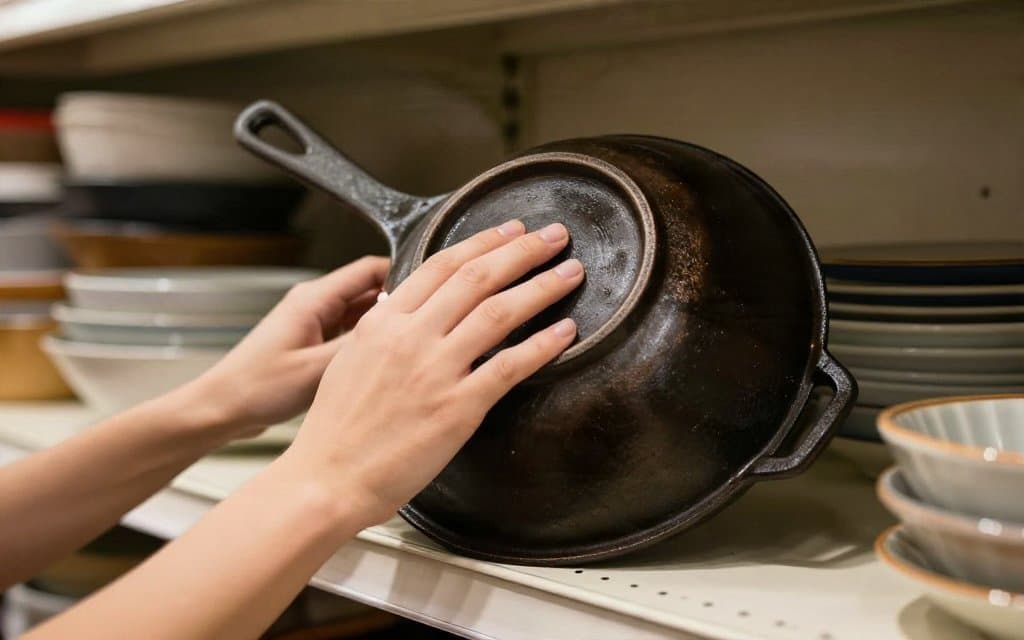
Spin test before you pay
Set the skillet face down on a flat surface in the store and press each edge. If it rocks, it's warped, and a #14 has to sit flat to earn its premium. Then look at it against a light for hairline cracks near the handle and rim.
- •Hairline cracks near the handle or along the rim
- •A wobble when the pan sits face down on a flat shelf
- •Deep pitting that shows through after cleaning
- •Any sign of fire damage, which collectors flag as a value hit
Shipping is the other cost people forget. Cast iron is heavy, and a big pan can eat a chunk of a modest sale, so price it in before you buy. Our breakdown of what eBay fees take from a flip shows how fast a thin margin shrinks.
Gate mark cast iron and other antique cast iron pans
Some of the oldest pans have no logo at all. A gate mark is an elongated ridge or scar across the bottom where molten iron entered the mold. Collectors on the Cast Iron Collector forum generally place gate-marked pieces before about 1880 to 1890, though they disagree on the exact cutoff, and an unmarked antique cast iron skillet is harder to sell than a branded one.
Griswold isn't the only name worth flipping over. Other antique cast iron pans with known marks sell well when clean, and they turn up in the same thrift aisles.
- •Wagner pie logo #13 with heat ring, about $800 to $1,000
- •Wapak Indian Head #8 with heat ring, about $400 to $700
- •Favorite Piqua Ware smiley #7, about $75 to $125 clean
- •Griswold #12 low dome cover with full markings, $300 and up
Pricing and selling vintage cast iron cookware
Don't trust asking prices. Search eBay's sold listings with a few variations like skillet, pan and fry pan, then match the logo, size, heat ring and condition to yours. Griswold Cookware also points out that a Best Offer Accepted sale only tells you the price was lower than the asking price.
- 1.Photograph the whole bottom so logo, size and Erie text show
- 2.Search sold listings with skillet, pan and fry pan variations
- 3.Match logo era, size, heat ring and condition to your pan
- 4.Skip Best Offer sales, since they hide the final price
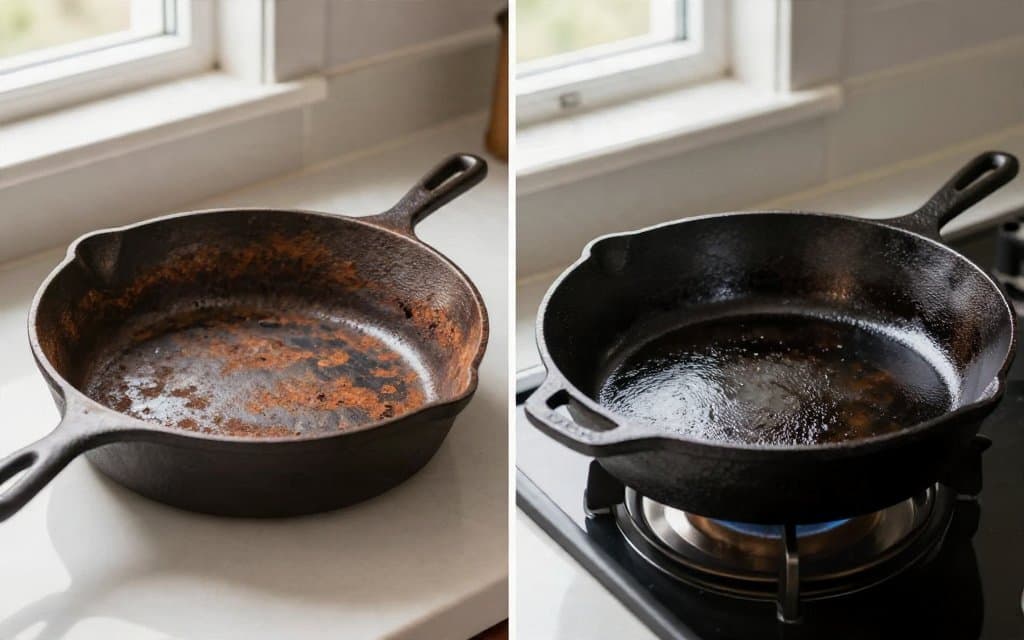
Clean pans photograph better, but don't scrub away markings or strip a pan with methods you haven't tried on cheap iron first. If you also pick up enameled pots in the same trip, our guide to cleaning thrift store Le Creuset covers that side, and the Corning Ware pattern guide helps with the dishes that usually sit beside the vintage cast iron cookware.
Pattern letters after the number, like the A or J on a #8, have no collector significance. Price by logo, size and condition instead.
Griswold cast iron identification questions resellers ask
Is a Griswold skillet without Erie worth anything?
It's worth what a good used pan is worth, which is real but modest. Erie production ended in December 1957, and collectors view Sidney-made Griswold as having limited appeal. Sell it as a cooker, not a collectible.
How can I tell a slant logo from a large block logo?
Look at the letters in GRISWOLD. Slant logos use italic lettering inside the cross, while large block letters stand upright and bold, usually with CAST IRON SKILLET above ERIE, PA, U.S.A. If you're unsure in the aisle, snap a photo and compare it against the tools at thrifting.app.
Do pattern numbers change the Griswold cast iron value?
The pattern number helps confirm a pan's design, but the letters after it don't matter to buyers. The Griswold & Wagner FAQ notes that researchers found nearly every letter of the alphabet on #8 block logo smooth bottom skillets.
Is Wagner cast iron worth as much as Griswold?
Usually less, with exceptions. A Wagner pie logo #13 with a heat ring brings $800 to $1,000 clean, which beats plenty of common Griswold pans. Later Wagner pieces and dual-marked pans sell as everyday cookware.
Ready to stop guessing at the thrift store? Snap a photo of that skillet bottom with Thrift Scanner, get real sold-market data on the logo and size, and never overpay for a Sidney pan again. Get the app here: iOS or Android.