


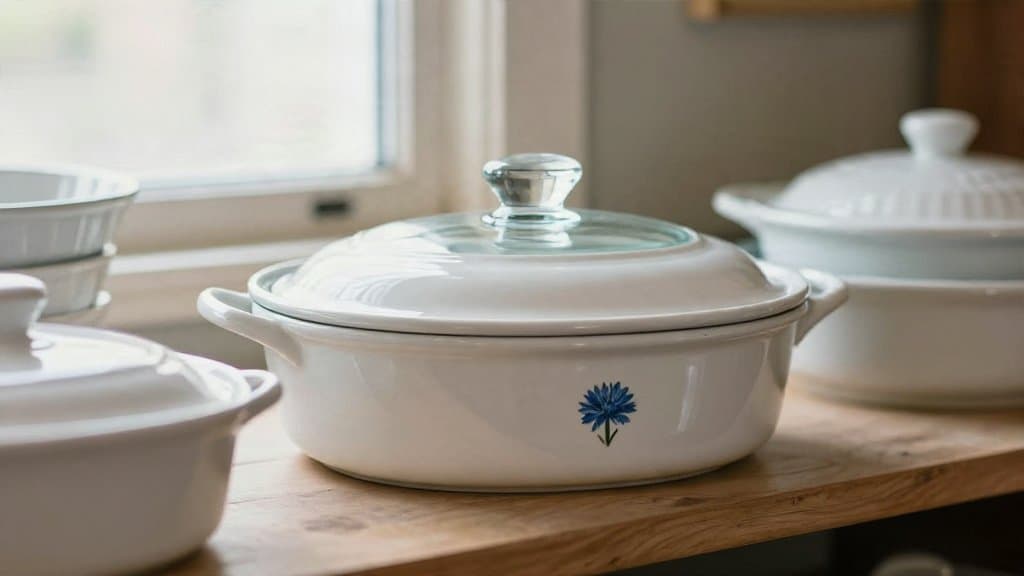
That casserole with the Corning Ware blue flowers on the side is probably worth about $15. It's the most common pattern the company ever made, and sold listings say so plainly, but a handful of other vintage patterns from the same shelves sell for $100 to $500 a piece.
The confusion comes from viral headlines. A WSLS report counted one pair of dishes listed near $16,000 and a La Marjolaine piece asking $4,900 that drew no early bids. Yet most eBay listings, Corning Ware blue flowers included, sit between $5 and $40, and that's the number to carry into a thrift store.
Why Corning Ware blue flowers turn up on every shelf
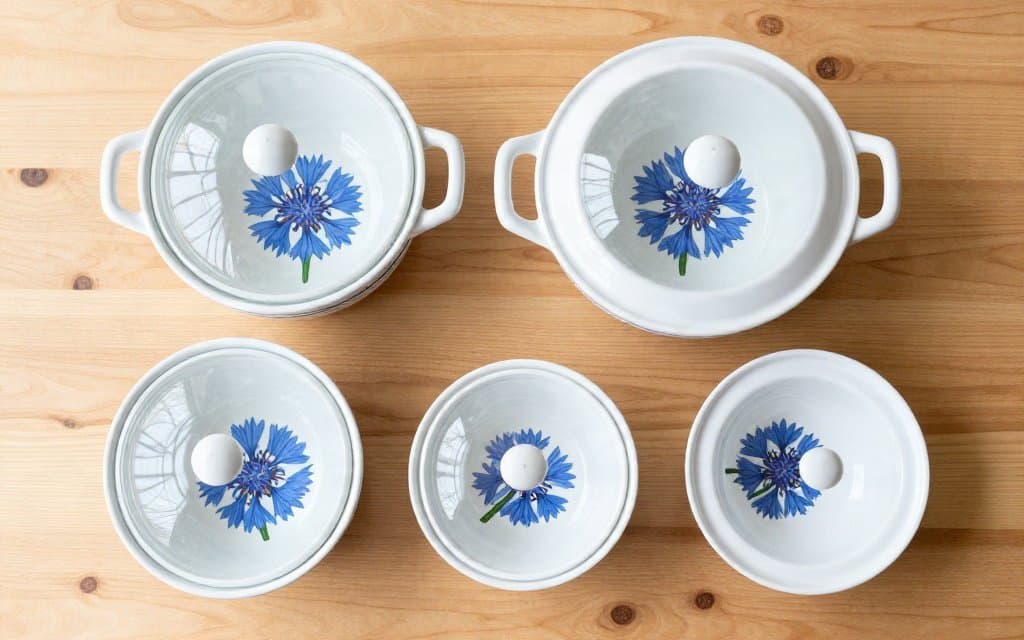
Corning launched its glass-ceramic cookware in 1958, and the Blue Cornflower design by artist Joseph Baum became the brand's face for three decades, according to the CorningWare history on Wikipedia. Antiques appraiser Dr. Lori dates the pattern to roughly 1958 through 1988. Thirty years of production means millions of casseroles in circulation.
That supply is why blue cornflower corningware rarely climbs past $30 for a single piece. Buyers can always find another one. The money is in the exceptions: early stamps, odd shapes, and the short-run patterns sitting right next to it on the housewares cart.
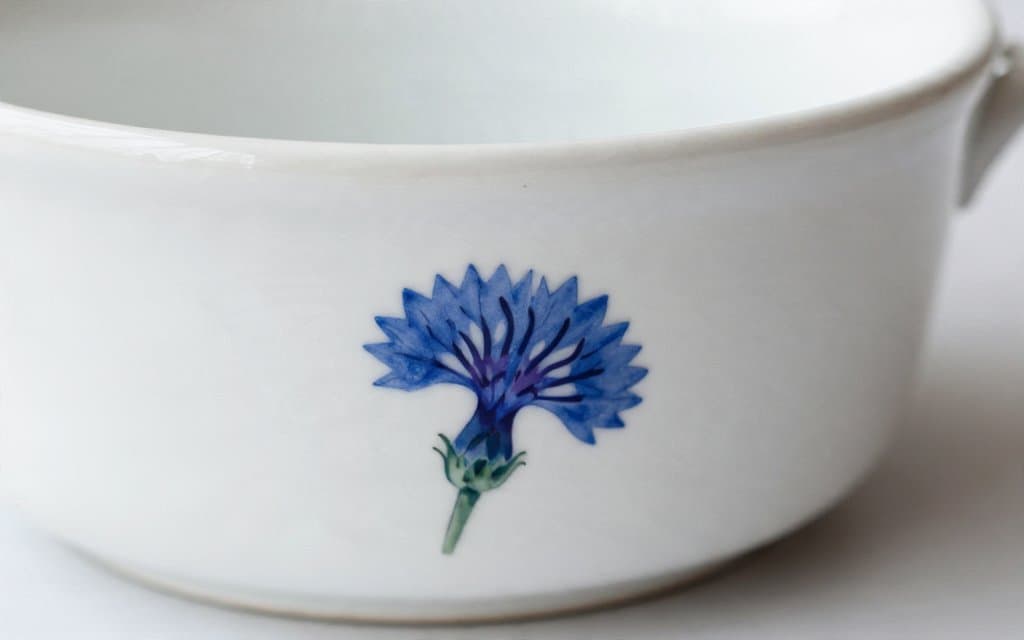
Small handles and embossed stamps point to older pieces
Dr. Lori notes that Blue Cornflower casseroles with small handles are older and worth more than later versions with enlarged handles. Hunker reports that pre-1960 pieces carry an embossed backstamp and can bring at least $100, while ordinary casseroles hover near $20.
- •Small side handles usually mean an earlier production run
- •An embossed backstamp suggests a piece made before 1960
- •Enlarged handles point to later, more common casseroles
- •Model numbers on the base help you match the right lid size
What vintage CorningWare really sells for right now
Sold comps tell a calmer story than the headlines. A resale tracker covering 351 recorded sales through October 31, 2026 shows common pieces of vintage CorningWare clustering in the teens, with only rare outliers breaking $100.
| Piece | Median sold | Sold range |
|---|---|---|
| Blue Cornflower P-1¾-B casserole, 1¾ qt | $14.70 | $4.20 to $37.35 (60 sales) |
| Cornflower Blue 9 inch pie plate P-309 | $9.95 | $3.25 to $25.00 (53 sales) |
| Blue Cornflower 9 cup stovetop percolator | $16.58 | $5.36 to $40.50 (34 sales) |
| Spice of Life A-10-B 2 qt casserole | $21.99 | $2.99 to $110.00 (44 sales) |
| Cornflower Blue 1.5 qt casserole, Pyrex lid | $14.18 | $10.00 to $48.00 (12 sales) |
Thrift stores typically tag CorningWare at $1 to $5 a piece. Buy a lidded Blue Cornflower casserole for $3, sell it for the $14.70 median, and you've grossed under $12 before platform fees and shipping a heavy, breakable dish. Our breakdown of how eBay fees eat into thrift flips shows why that margin shrinks fast.
The $10,000 and $25,000 figures that go viral are asking prices, not sales. Most CorningWare sells for under $50, so price from sold listings and ignore what hopeful sellers are asking.
Why a full set of Corning Ware dishes beats single pieces
An original matching lid can push a piece to two or three times its bare price, since so many Pyrex lids got lost or broken. Common-pattern sets with lids sell for $30 to $100, so bundling four or five Corning Ware dishes you bought at $2 each turns a weak flip into a decent one.
Rare CorningWare patterns worth grabbing on sight
The patterns that pay were made briefly, sold on odd shapes, or both. These are the ones that show up in real auction and sold results, not just in wishful listings.
| Pattern | Made | Typical value |
|---|---|---|
| Wildflower | 1977 to 1984 | $100 to $500, large lidded casseroles highest |
| Floral Bouquet | Late 1960s to 1975 | About $200 earliest; $20 to $30 later |
| Renaissance | 1970 | $100 to $300 per dish |
| Duck (tinted lid) | Before mid 1990s | $225 to $300 per casserole |
| Black Starburst | 1959 to 1963 | $100 to $300 for good pieces |
Blue Heather is the lookalike worth a second glance
Dr. Lori lists Blue Heather from the mid-1970s as a pattern that resembles Blue Cornflower closely enough that it often sells for higher prices. If a blue floral dish looks slightly off from the classic cornflower motif, flip it over and read the base before you walk past it.
Percolators and short promotional runs
Hunker points out that the Say It With Flowers designs from 1971 and 1972 appeared only on P-80 electric percolators, and a single American Autumn plate was listed at $150. Dr. Lori also flags Butterscotch, made in 1969 only, and Platinum Filigree from 1966 to 1968 as scarce.
- •Wildflower: orange poppies and mixed blooms, 1977 to 1984
- •Floral Bouquet: blue and yellow flowers, earliest on a yellow ground
- •Renaissance: boats docked at a port, a 1970 gift line
- •Black Starburst: atomic stars on percolators from 1959 to 1963
- •Duck: a single speckled mallard with a tinted, not clear, lid
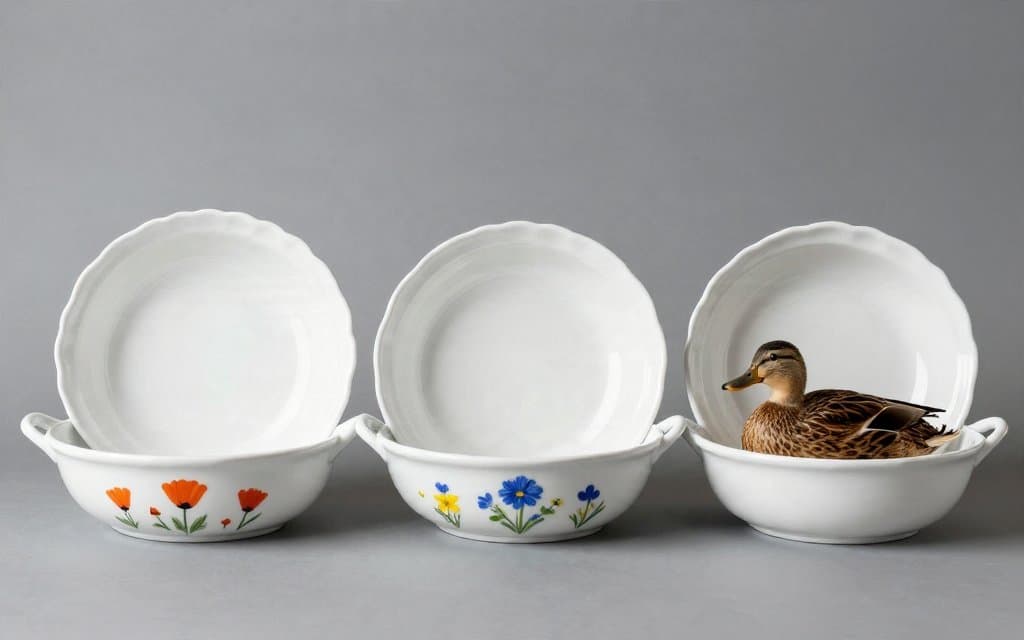
In the Wild! Shopping Corningware Patterns & Revealing Marks & Values - Thrift with Me Dr. Lori
The Corning Ware vegetable pattern sits in the middle
Spice O' Life, the earth-toned Corning Ware vegetable pattern with tomatoes, onions, mushrooms and artichokes, ran from 1972 to 1987. House Digest notes that earlier pieces may carry French labels like L'Echalote or La Marjolaine, and that single pieces go for up to about $50 online.
It's the second most common pattern after Blue Cornflower, so treat it like a volume item rather than a jackpot. If you already flip kitchenware, the same buyers chase the Pyrex Spice of Life pattern, and matched sets across both brands sell well locally. Anyone hunting a Corning Ware fruit pattern should read the base too, since the pattern name is often printed there.
Where a CorningWare petite pan or pie dish fits in
Size changes the math. Three-quart casseroles, Dutch ovens and range toppers outsell a CorningWare petite pan, though a Wildflower petite pan or saucepan still reaches $100 to $200. A common Cornflower CorningWare pie dish, the P-309, has a median sale of $9.95, so it's a bundle filler, not a solo listing.
- •Big lidded casseroles carry the highest prices in any pattern
- •Group petite pans with their lids instead of listing them solo
- •A common pie plate is worth listing only inside a bundle
- •Range toppers and Dutch ovens bring more than small saucepans
How to tell vintage Pyroceram from newer stoneware
Original pieces are Pyroceram, a glass-ceramic that S. Donald Stookey discovered in 1953. After Corning sold the brand in 1998, the name moved onto stoneware bakeware, which is heavier, fully opaque and not safe on a burner. Dr. Lori's rule is simple: anything marked "Not for Stovetop Use" isn't Pyroceram.
Pyroceram was an accident. Stookey left a sample in a furnace set near 900°F instead of 600°F, it turned milky white, and when it slipped to the floor it didn't shatter.
Pyroceram returned to U.S. stores in December 2008 as CorningWare StoveTop, made in France, so a stovetop-safe piece isn't automatically old. Check the pattern, the stamp and the handles together, the same way you'd read the backstamp on vintage Fiestaware.
- •"Not for Stovetop Use" on the base means modern stoneware
- •Stoneware is heavier and fully opaque, unlike the old Pyroceram
- •Classic patterns on stoneware still carry little resale value
- •Pieces made before 1999 count as vintage for most buyers
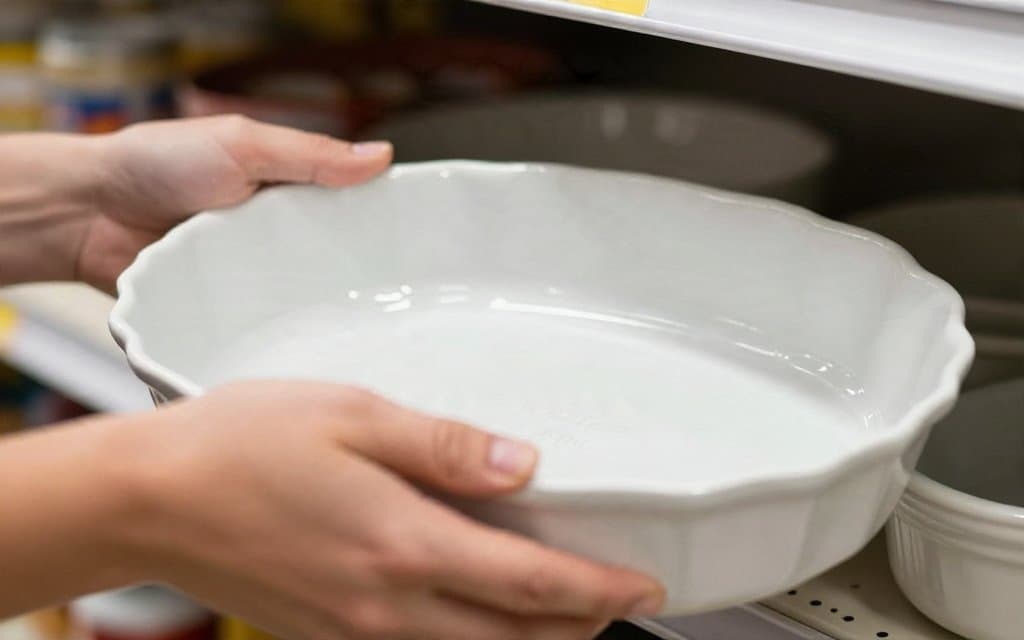
Condition and lids decide your CorningWare value
Exterior chips or cracks can cut a piece's price in half or make it unsellable to collectors. Light utensil marks inside are usually fine, and brown cooking stains on the bottom often clean up. Deep discoloration and faded decoration are what really hurt CorningWare value.
Clean before you photograph, because a bright white CorningWare casserole dish looks far better in listing photos than a grey one. Our Le Creuset cleaning guide covers prepping kitchenware for sale. Loose Pyrex lids sell on their own, so don't toss a spare.
Run your fingertip around the rim and handles before you pay. A chip you can feel is a chip a collector will find, and it can halve the sale price.
Questions resellers ask about vintage CorningWare
Is Blue Cornflower CorningWare worth anything?
Yes, just not much alone. Single pieces run about $5 to $30 and lidded sets $30 to $100, so it's a solid flip under $3 a piece and a poor one at $8. Older pieces with small handles or an embossed stamp are the exception.
Which rare CorningWare patterns are worth the most?
Wildflower, early Floral Bouquet, Renaissance, the tinted-lid Duck casseroles and Black Starburst consistently sell in the $100 to $500 range. Pristine examples of very scarce patterns occasionally pass $1,000, but that's a rare sale, not a price guide.
Can you still cook in vintage Corning Ware dishes?
The Pyroceram bodies were sold for freezer, stovetop, oven, broiler and microwave use. The glass lids are a different material, though, and Wikipedia notes they can't take direct heat, so keep them off the burner.
Ready to stop guessing which casserole is the $15 one and which is the $300 one? Download Thrift Scanner, snap the pattern and the backstamp, and get real sold data before you pay. More guides live at thrifting.app. Get the app here: iOS or Android.