


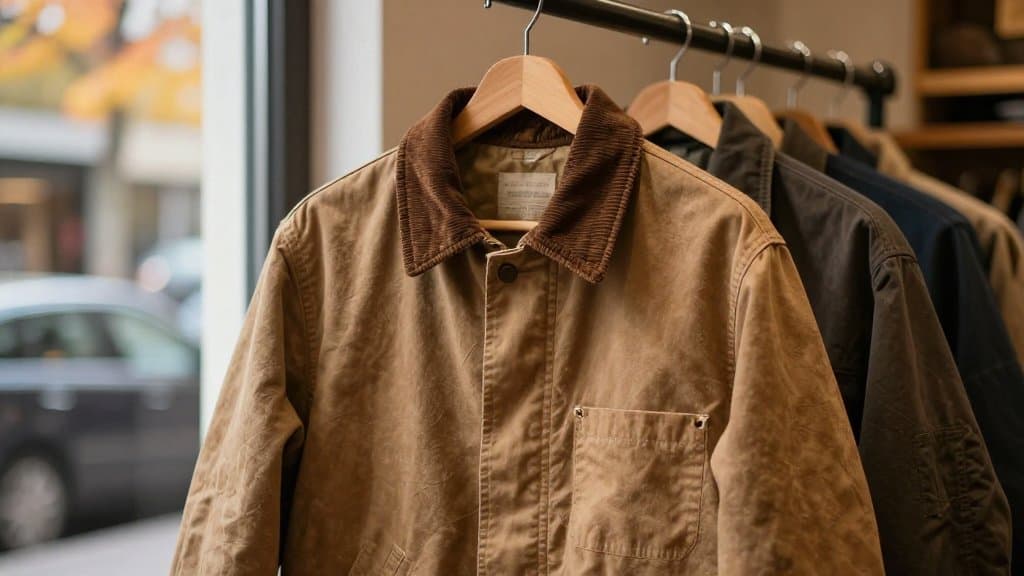
That brown canvas jacket with the square C patch on the thrift rack might not be the vintage grail you think it is. Plenty of shoppers grab a Carhartt WIP Detroit jacket, see the famous shape, and assume they've found an old American workwear piece worth hundreds. Sometimes they have. Often they're holding a modern European fashion jacket instead.
Neither one is junk, but they sell to different buyers at very different prices. A Carhartt WIP Detroit jacket is a current streetwear product with its own fans, while a blanket-lined, USA-made Detroit from the 1990s is what workwear collectors chase. Knowing which one is in your hands takes about thirty seconds once you know where to look.
Why a Carhartt WIP Detroit jacket fools so many thrifters
The two jackets share a silhouette, a corduroy collar, and the same company name on the label. Carhartt licensed its classic designs to a European partner decades ago, so the WIP version is a real, authorized Carhartt product. It just isn't the old workwear version, and the tags say so if you read them.
Hamilton Carhartt started making overalls in duck and denim in 1889 with four sewing machines and five employees. The workwear side of the brand has been selling chore coats and zip jackets to tradespeople ever since, which is why worn-in pieces carry so much history.
Carhartt Work in Progress began as a European distributor
According to Carhartt WIP's own history page, Edwin Faeh founded Work in Progress in 1994 as the exclusive European distributor of Carhartt. In 1996 it won the license to make Carhartt products outside the USA, and its first collection arrived in 1997 alongside a shop on Neal Street in London.
- •1889: Hamilton Carhartt starts making duck and denim overalls
- •1954: the zip jacket later called the Detroit goes on sale
- •1994: Edwin Faeh founds Work in Progress in Europe
- •1996: WIP gains the license to produce outside the USA
- •1997: first Carhartt Work in Progress collection launches
If the tag says Work in Progress or WIP, you're looking at a modern fashion piece made under license, not a vintage American workwear jacket.
How the original Carhartt Detroit jacket became a classic
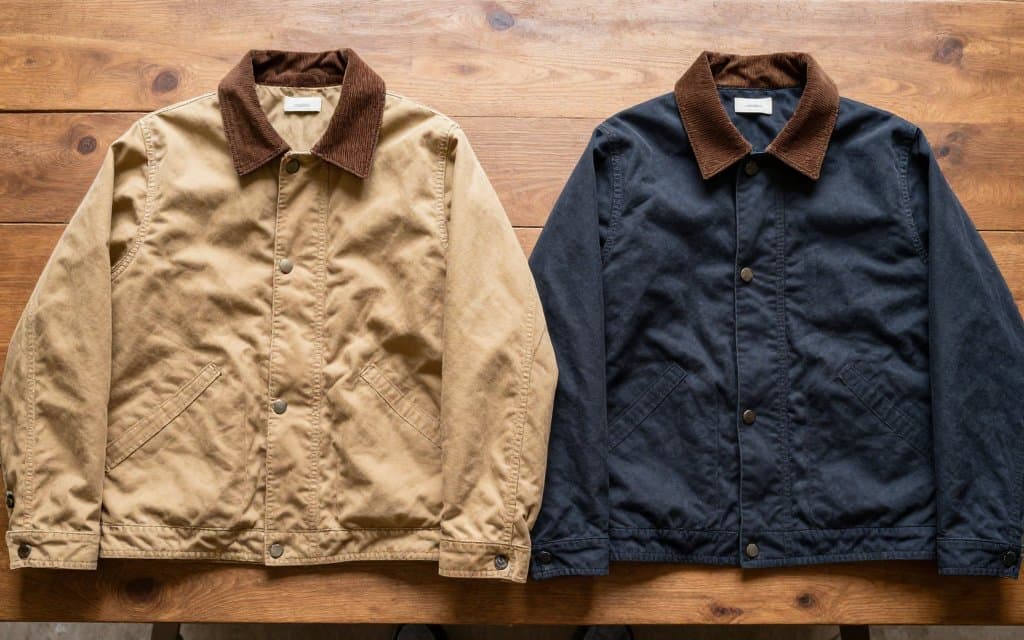
Workwear historian Carl Murawski notes in his history of the Detroit jacket that it launched in 1954 as an Eisenhower style zip jacket in blue denim. Brown duck followed in 1955. Here's the surprising part: Carhartt didn't officially call it the Detroit Jacket until 1998, nearly 45 years after it hit the market.
Over the decades the jacket picked up different linings, colors, and model codes. In 2014 Carhartt even sold a weathered duck version, the J001, made in Mexico for only about three years. That short run is one reason model codes matter so much when you price a find.
What makes the Carhartt J97 the one to grab
The Carhartt J97 is the code collectors know best. It used sandstone-washed duck, came with a blanket lining and quilted sleeves, and was cut roomy and boxy with a straight hem. A USA-made one in an even fade is the jacket most resellers mean when they say vintage Detroit.
- •Model code J97 or J01 printed on the inside care tag
- •Blanket lining in the body with quilted lining in the sleeves
- •Boxy cut with a straight hem rather than a dropped tail
- •Corduroy collar that has faded evenly with the canvas
- •Made in USA tag, ideally with a union label beside it
Carhartt tags by year tell you the era in seconds
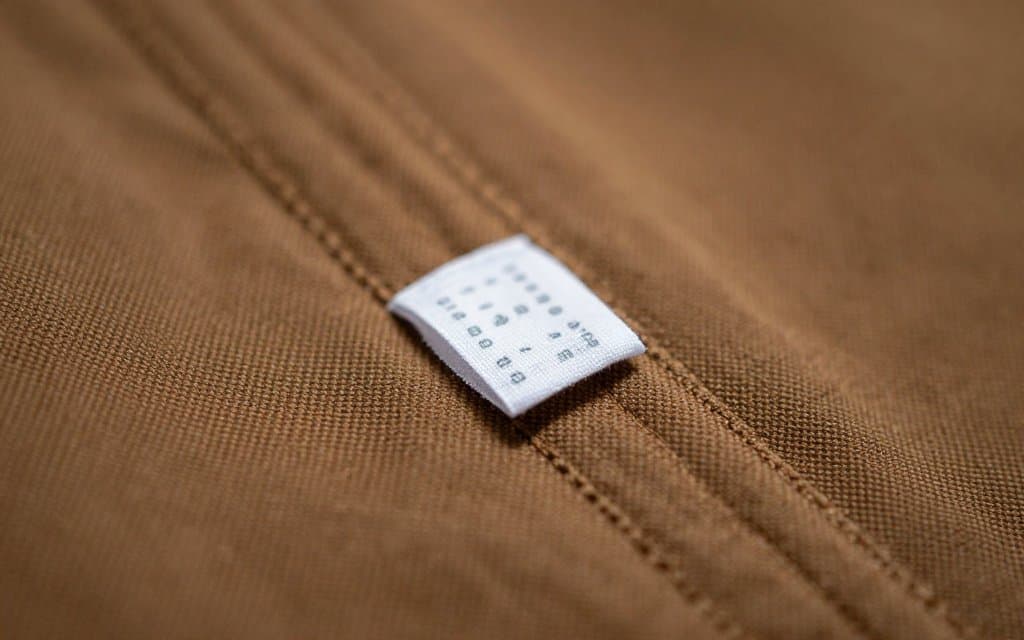
Flip the jacket open before you look at anything else. Most Carhartt pieces from the 1990s onward carry a small white care tag near the neck or side seam with a three or four digit production code, and reading Carhartt tags by year is the fastest way to date a jacket on the spot.
Reading the four-digit date code
The first one or two digits are the month and the last two are the year. So 598 means May 1998, 0301 means March 2001, and 1091 means October 1991. Pair that with the country of origin and you've got a reliable bracket for when the jacket was sewn.
- 1.Find the white care tag at the neck or along the side seam
- 2.Read the last two digits of the date code as the year
- 3.Read the digits before them as the month of production
- 4.Check the country of origin printed on the same tag
- 5.Look for a union label, a strong sign of older production
Union labels and Made in USA tags
A union label beside a Made in USA tag points to older domestic production, and collectors treat it as one of the strongest value signals. Country of origin alone roughly splits jackets into pre and post 2004, when production had largely moved offshore. A Carhartt WIP jacket tag simply says imported.
Made in USA plus a union label plus a 1990s date code is the combination that moves a cheap thrift jacket into the $150 to $400 resale tier.
Side by side, the WIP and mainline jackets differ in five places
If the tags are cut or faded, construction gives the game away. A reviewer at Stridewise who owned both found the WIP version softer and more fitted, while the mainline jacket stayed stiff and roomy for a long time. You have to earn a soft Detroit, as that reviewer put it.
| Feature | Carhartt WIP | Mainline Carhartt |
|---|---|---|
| New price | $298 for the OG Detroit Jacket (Winter) | About $110 in regular sizes per Stridewise |
| Canvas | 12 oz organic cotton Dearborn canvas | Stiff duck canvas that softens with wear |
| Lining | Diamond quilted on winter, unlined summer | Blanket lining on the classic version |
| Fit | Slimmer, European style cut | Boxy and roomy with full swing shoulders |
| Origin tag | Imported | Imported now, Made in USA on older jackets |
That $298 price tag explains why some thrifters get excited about a WIP find. It's still a good jacket. But a buyer paying top money for a vintage Carhartt jacket wants the faded duck, the blanket lining, and the old tag, none of which a WIP piece has.
Can You Spot The Difference Between These Two Jackets? - Carhartt Detroit Jacket Review
What each used Carhartt jacket is worth on resale sites
Here's where the difference turns into money. Cluzy's 2026 Carhartt resale guide puts vintage J97 era Detroits at $150 to $400 or more, while a common modern brown Detroit sells for roughly $60 to $150. Discontinued colors can push a jacket to $435.
| Jacket Type | Key Tell | Resale Range |
|---|---|---|
| Vintage J97 era Detroit | Blanket lining, often USA made | $150 to $400+ |
| Discontinued colorway | Rare color on an older tag | $200 to $435 |
| Reissue or collab | WIP or collab branding | $120 to $300+ |
| Common modern Detroit | Brown, imported, recent date code | $60 to $150 |
| Modern Active or chore coat | Current production tags | $40 to $100 |
Those are used prices before fees, and thrift stores rarely price a vintage Carhartt Detroit jacket anywhere near them, which is where the profit sits. A WIP piece falls into the reissue and collaboration bucket, where price depends on color, season, and hype rather than age.
On Grailed, a vintage Carhartt Detroit jacket in good shape often goes for $250 or more, and some top $400.
- •An older USA made or union tag adds the most to the price
- •Detroit and hooded Active models outsell plain zip jackets
- •An even, honest fade beats fresh stains or heavy patching
- •Rare colors like moss, petrol, and chestnut draw more bids
- •Intact zippers and cuffs save buyers a trip to the tailor
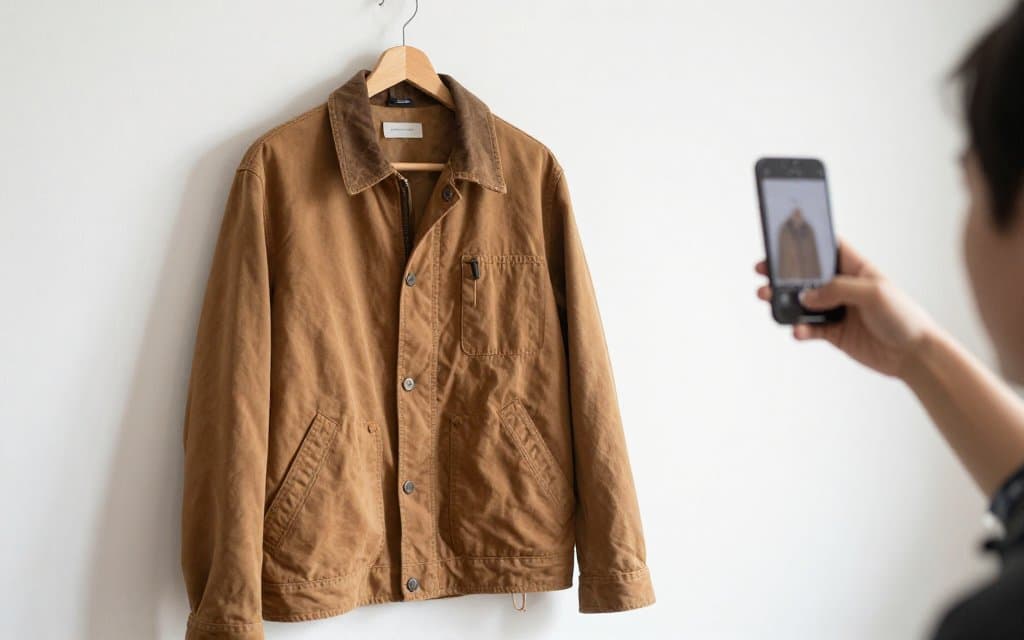
A Carhartt chore coat or Carhartt active jacket is worth a look too
The Detroit gets the headlines, but the same tag checks work on every Carhartt duck jacket you find. Carhartt WIP's history notes that the C01 Carhartt chore coat was first advertised in 1923, and older blanket-lined versions with a union label sell to the same collectors who chase Detroits.
The hooded Carhartt active jacket is the other strong seller, especially in faded brown. Treat any used Carhartt jacket like a puzzle: model code, date code, country, then condition. Our guide to dating old Levi's uses the same tag-first habit for denim.
- •J01 and J97 are Detroit jackets on the care tag
- •J03, J68, J130, J131, and J140 belong to the Active line
- •C01 and C02 mark the classic chore coat styles
- •C03 and C26 are the heavier traditional Arctic coats
- •Color codes like BRN, MOS, and PTL sit beside the model code
Questions thrifters ask about vintage Carhartt jackets
Is a Carhartt WIP jacket worth buying secondhand?
Yes, if the price is right and the color is popular. A WIP piece won't fetch vintage money, but a clean OG Detroit that retails for $298 new still has buyers on Depop and Grailed. Just price it as a modern fashion jacket, not as a 1990s workwear find.
How do I tell if a vintage Carhartt jacket is real?
Start with the care tag. A real vintage piece has a sensible date code, a country of origin that fits that date, and often a union label on USA-made examples. Stitching should be heavy and even, and the corduroy collar should fade at the same pace as the canvas around it.
Is a Carhartt duck jacket the same as a Detroit?
Not always. Duck is the heavy cotton canvas Carhartt uses across many jackets, including the Active, the chore coat, and the Detroit. The Detroit is the specific waist-length zip style, so check the model code before you list it under that name.
For more tag reading practice, see how a single stitch hem dates a vintage tee or what a Louis Vuitton date code reveals about a thrifted bag. More resale guides live at thrifting.app.
Ready to stop guessing whether that canvas jacket is a WIP or a true vintage Detroit? Download Thrift Scanner, snap a photo of the jacket and its tag, and get real sold-listing data before you pay. Never overpay for workwear again. Get the app here: iOS or Android.