


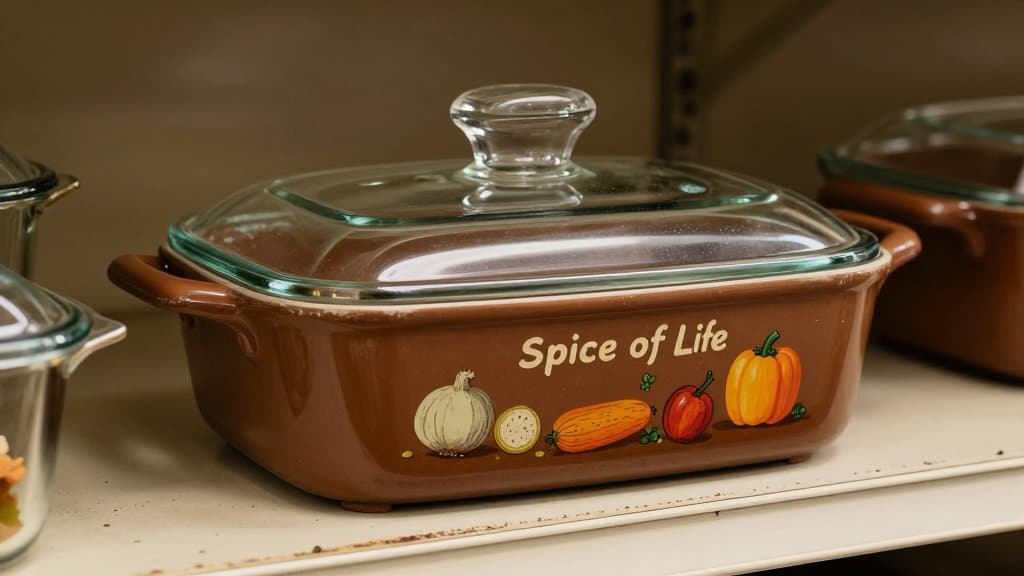
That brown casserole covered in vegetables and French phrases, the one most thrifters call the Pyrex Spice of Life pattern, is not worth thousands no matter what a viral post told you. Real sold listings put most pieces between $15 and $40. For anyone reselling secondhand finds, knowing that before you pay is the whole game.
Here is the catch that trips up new flippers. Spice of Life is not Pyrex at all. It is CorningWare, made from a ceramic glass called Pyroceram, and it usually shows up wearing a clear Pyrex lid, which is exactly where the name mix-up begins. The patterns that actually pay live in a different group, and the resale value gap between them runs into the thousands.
How to spot the Pyrex Spice of Life pattern
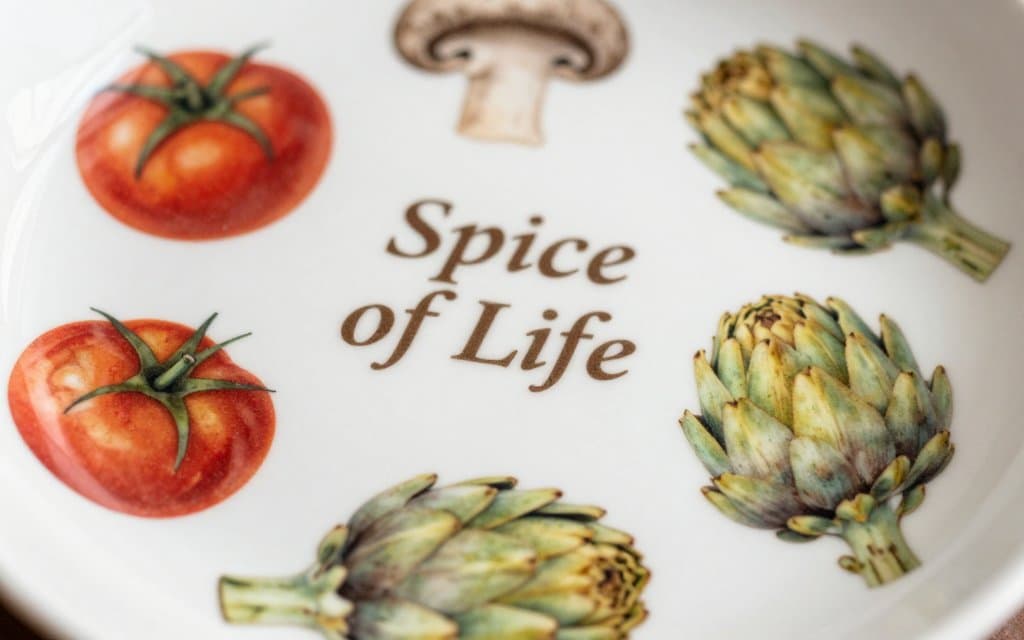
The print is easy to recognize once you know it. Look for earth-tone tomatoes, mushrooms, artichokes, garlic, and peppers scattered across a white body, with short French phrases tucked under the produce. Collectors nicknamed it French Spice, and to most shoppers it reads as a pyrex vegetable pattern even though the body is CorningWare. It ran from 1972 into the late 1980s and coordinated with Corelle Spice of Life dinnerware.
The lid is your fastest tell. The clear glass top is stamped Pyrex, while the dish underneath carries a CorningWare mark and a model code like P-43-B. That split is why the two brands get blended together on price tags and in listings. Because it belongs to the CorningWare family, it helps to see how a genuinely collected line like La Marjolaine CorningWare behaves at resale.
- •Earth-tone tomatoes, mushrooms, and artichokes on white
- •Short French phrases printed beneath the vegetables
- •Clear lid stamped Pyrex, body stamped CorningWare
- •Model codes such as P-43-B molded into the base
- •Coordinates with the matching Corelle dinnerware set
What Spice of Life is really worth
Real numbers first. Smaller pieces move for about $10 to $35, mid-size covered casseroles land around $20 to $45, and only a sealed or unused large piece pushes past $100. A CorningWare reference guide lists a new 5 quart casserole at about $145, which is the ceiling, not the norm.
So where did the thousand-dollar rumor come from? Social posts pluck a single wildly overpriced listing and treat it as a sale. That is not how vintage pyrex value works. A price nobody pays is not a price, and chasing it is how resellers end up with dead stock.
A listing price is a wish. Only a completed sale tells you what a piece is actually worth.
The common Pyrex patterns you will see most
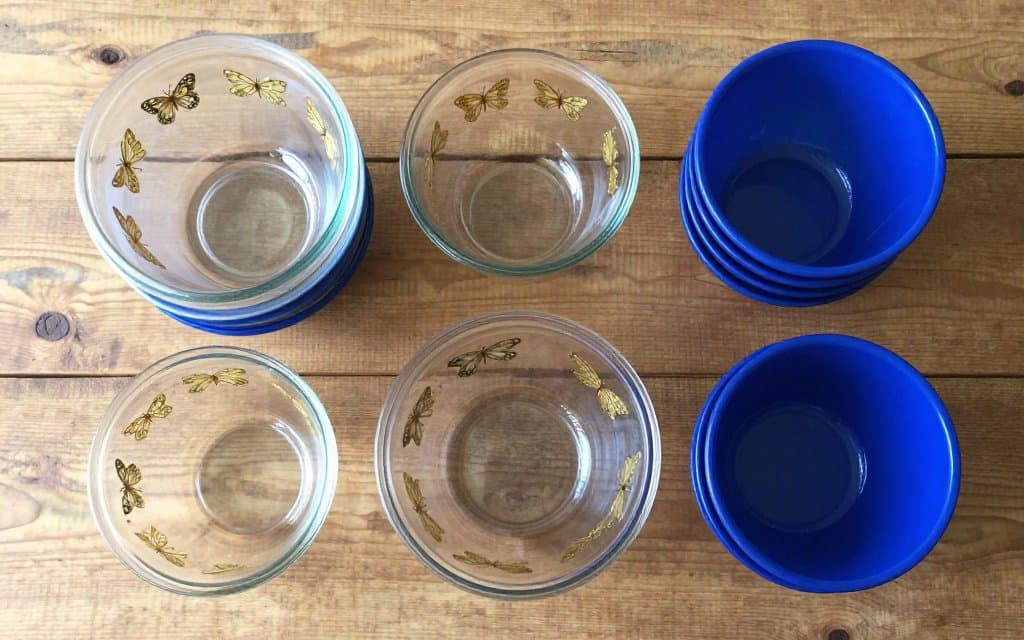
Once you step past this pattern, real Pyrex opens up, and most of what you will handle is still common. Butterfly gold pyrex is the harvest-gold flower print from the 1970s that sits on nearly every thrift shelf. A butterfly gold pyrex casserole with its lid usually sells for $15 to $40, and single bowls often go for less.
The harvest-gold and green era
The other everyday names follow the same math. Old town blue pyrex, the blue Cinderella bowls, and the green Pyrex bowl with white flowers that collectors call Spring Blossom all trade in the $15 to $60 range. The pyrex olive pattern in Verde green and short-run prints like snowflake garland pyrex can climb higher when a set is complete. For a sense of how condition swings glass prices, our guide to depression glass values shows the same rarity beating volume.
| Pattern | Era | Value |
|---|---|---|
| Butterfly Gold | 1970s | $15 to $60 |
| Old Town Blue | 1960s to 70s | $15 to $50 |
| Spring Blossom | 1970s | $15 to $60 |
| Snowflake Garland | 1970s | $40 to $150 |
| Verde Olive | 1960s to 70s | $20 to $60 |
- •A matching lid, which many bowls have lost
- •A full nesting set rather than one orphan bowl
- •Bright print with no dishwasher fade or scratches
- •A less common colorway inside a popular pattern
The rare Pyrex patterns worth real money
Now the fun part. A small number of rare pyrex patterns are the reason people dig through kitchenware bins at all, and this is where the phrase pyrex patterns worth money actually earns its keep. These are promotional runs and short-lived designs that rarely surface, and the same collector heat lifts Fire King jadeite values right alongside them.
Atomic Eyes, Pink Stems, and the true grails
The atomic eyes pyrex chip and dip set, with its original metal bracket, has sold for around $1,450. A pink version of the farmer print, the pyrex farmer pattern known as Butterprint, brings up to $700 as a complete set. Rarer still, a single Blue Dianthus mixing bowl sold for $3,600, and a Turquoise Golden Birds casserole set the record near $6,000, according to documented eBay sales. The 1959 Lucky in Love promotional pattern regularly clears four figures.
| Pattern | Top sale | Note |
|---|---|---|
| Atomic Eyes chip and dip | $1,450 | With metal bracket |
| Pink Butterprint set | $700 | Complete with lids |
| Blue Dianthus bowl | $3,600 | Single mixing bowl |
| Turquoise Golden Birds | $6,000 | Record eBay sale |
| Lucky in Love | $1,000+ | 1959 promotional |
One Blue Dianthus bowl outsold a whole pallet of Butterfly Gold. Rarity, not age, drives the top prices.
How model numbers and stamps date your Pyrex
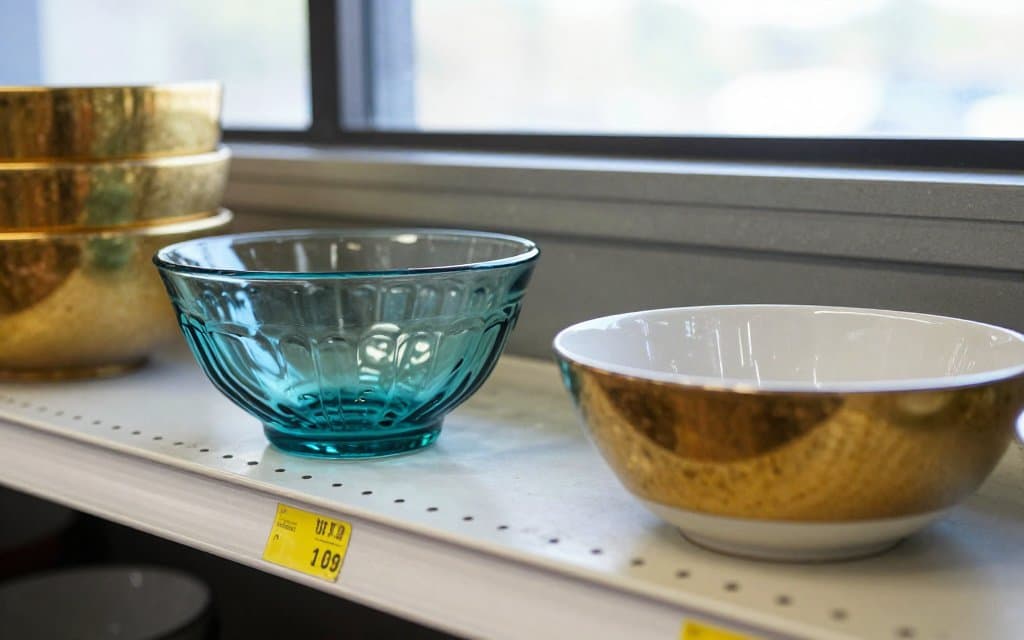
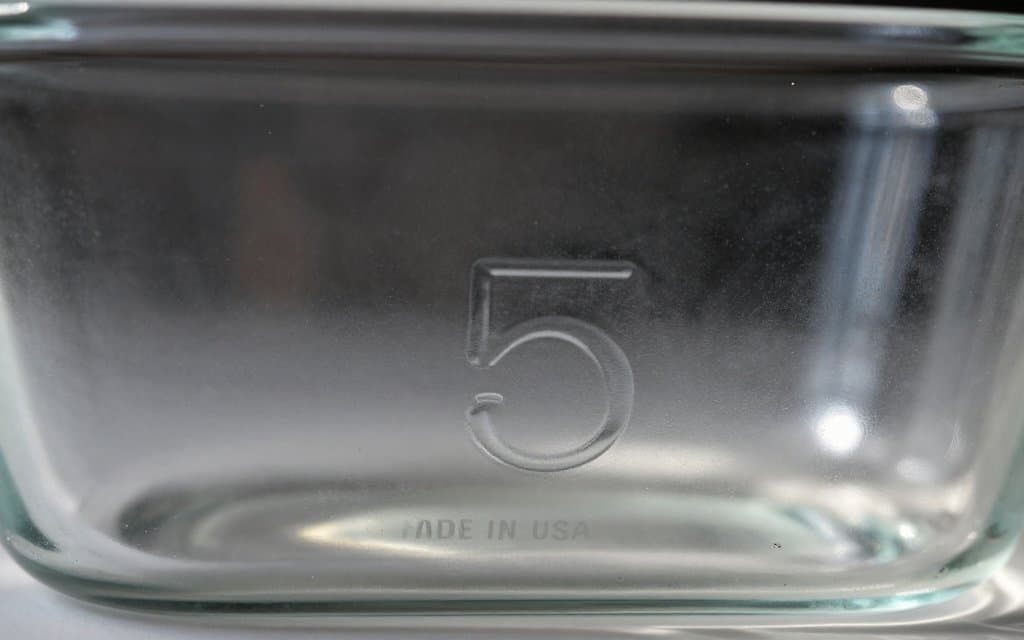
Every real Pyrex piece carries a shape number, and learning the ranges lets you date and identify vintage pyrex patterns on the spot. Round mixing bowls run 401 to 404, the handled Cinderella bowls with pour spouts run 441 to 444, and the fridge dishes run 501 to 503. A widely cited In Color Order number chart lays out the exact sizes.
The backstamp dates the piece too. Early antique pyrex patterns wear an all-capital PYREX mark in a circle, while later ones use lowercase and add MADE IN USA. Collectors treat the all-caps stamp as a sign of older, thicker glass, and that small detail can nudge a price up.
- •401 to 404 are round nesting mixing bowls
- •441 to 444 are handled Cinderella bowls
- •501 to 503 are the fridge storage dishes
- •All-caps PYREX stamp points to older glass
What condition does to your resale value
Condition is the quiet lever on every sale. A bright, unscratched print in a complete set can be worth three to five times a faded, lidless single of the same pattern. Dishwasher wear is the usual killer, since decades of hot cycles dull the print and drop a bowl from collectible to kitchen-use. Missing lids alone can cut a set price by 30 to 50 percent.
This is where a quick check pays off before you buy. With the Thrift Scanner app you can photograph a piece, match the pattern, and see real sold comps in seconds, so you are pricing against what actually sold rather than a hopeful listing. You can start from the thrifting.app home page and scan your next find.
- •Bright print with no scratches or dishwasher haze
- •Original lid present and free of chips
- •Complete nesting set over a single orphan bowl
- •No cracks, stars, or heavy utensil marks
A faded, lidless bowl is worth kitchen money. The same pattern, minty and complete, is worth collector money.
Common questions about vintage Pyrex value
Is the Pyrex Spice of Life pattern worth anything?
It has value, just modest value. Most of these pieces sell for $15 to $40, with only sealed or unused large casseroles reaching past $100. Remember it is CorningWare with a Pyrex lid, and the thousand-dollar claims online are wishful listings, not real sales.
How do I know if my vintage Pyrex is rare?
Match the pattern and colorway against sold listings, not asking prices. Promotional runs like Lucky in Love and short-lived prints are the genuinely rare pyrex patterns, while harvest-gold and blue everyday lines are common. A complete set with a bright print and its lid always outperforms a lone bowl.
Why do butterfly gold pyrex casserole sets sell so easily?
They sell fast because buyers still use them. A butterfly gold pyrex casserole is durable, oven safe, and nostalgic, so it moves quickly even at $15 to $40. Volume is your friend here, since steady turnover beats waiting months for one rare piece.
Where can I find current Pyrex prices?
Check completed eBay listings for your exact pattern, shape number, and lid status, since that is the closest thing to a live market. Scanning apps speed this up by pulling recent sold data for you. Cross-check a few sales before you set a price, because one outlier can skew your read.
Ready to stop guessing and start profiting on kitchenware? Thrift Scanner identifies patterns instantly and shows real market value from millions of sold listings, so you never overpay for a common bowl or walk past a rare one again. Snap a photo, get the numbers, and buy smart. Get the app here: iOS or Android.