


Most Fenton you'll find at a thrift store is worth less than the price tag suggests, and a white hobnail milk glass bowl is the piece people overrate most often. The good news is that the molded mark on the base, or the lack of one, narrows down the age in a few seconds and points you toward the handful of pieces that actually sell.
Fenton glass came out of Williamstown, West Virginia, from 1907 until the company stopped traditional glassmaking in July 2011, so there's a huge amount of it in circulation. That's exactly why price varies so much. One June 2026 estate sale moved five assorted Fenton milk glass pieces for $8.05 in total, while a pedestal mosaic art vase brought $5,500 at an online auction.
Fenton glass marks date a piece to the decade
Flip the piece over first. A raised script "Fenton" inside an oval means it was made in 1970 or later, because that's when the company started molding its logo into the bottom of carnival glass. By 1974 the logo was on nearly all production.
The oval logo and its tiny decade digit
Look just under the "n" in the logo. Fenton added a single digit there to show the decade, so an 8 means the 1980s, a 9 means the 1990s and a 0 means the 2000s. A 1 points to the final years before production wound down.
| Mark | Dates | What It Means |
|---|---|---|
| Blue paper label | 1957 to 1971 | Reads "Authentic Fenton Handmade", often peeled off |
| Gold or black label | 1970 to 1985 | Paper label, may sit beside a molded logo |
| Oval logo, no digit | Early 1970s | Molded script Fenton, before decade digits |
| Oval logo with 8, 9, 0 | 1980s, 1990s, 2000s | Digit under the n gives the decade |
| Script F in oval | 1980 to 2011 | Made from molds Fenton bought from other firms |
| Flame, star or block letter | Varies | A preferred second, which sells for less |
Paper labels on older Fenton glassware
No mark doesn't mean no Fenton. Unmarked pieces are common from the 1930s through the 1960s, when the company relied on paper labels instead of molded logos. Check the base for a sticky ghost or a scrap of blue paper, since that label alone can push an unmarked bowl into the 1957 to 1971 window.
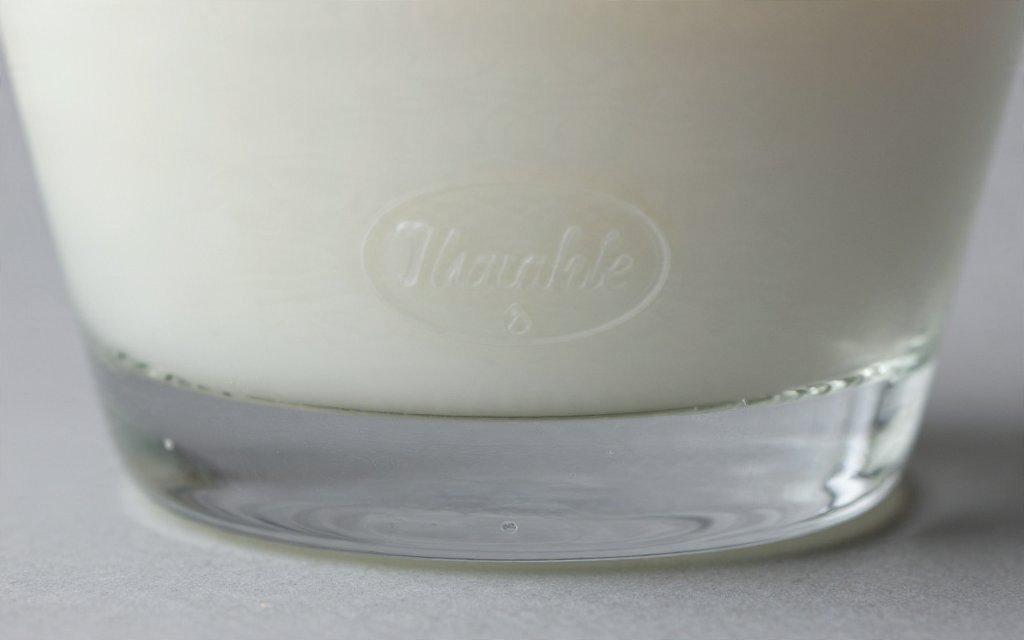
A raised oval Fenton logo means 1970 or later. A digit under the n gives the decade. No logo at all often means older, not fake.
Why a hobnail milk glass bowl usually sells cheap
Fenton started selling Hobnail in 1940 in French Opalescent, Green Opalescent and Cranberry Opalescent, and it became the company's top-selling line. Milk glass versions followed and were produced for decades. Top sellers make great history and poor profit, because every shelf in every Goodwill seems to have one.
What Fenton milk glass really sells for
Small hobnail and milk glass vases, bells and slippers usually land between $5 and $45 on the resale market, per Relic's Fenton value data. Larger milk glass baskets, pitchers, lamps and four-horn epergnes reach $20 to $200. That spread matters: a plain bowl sits at the bottom, and a complete epergne with all its horns sits near the top.
- •Small hobnail vases, bells and slippers: $5 to $45
- •Milk glass baskets, pitchers and lamps: $20 to $200
- •Five mixed milk glass pieces at a 2026 estate sale: $8.05
- •A rim flea bite can cut the value by 30 to 50 percent
So when a white hobnail bowl is priced at $12, you're paying close to what it'll sell for. Walk past it unless it's part of a matching set, or it's opalescent rather than solid white. Colored Fenton hobnail, especially cranberry, is a different story.

Which Fenton art glass actually pays
The money in Fenton art glass sits in color, set completeness and short production runs. Across 84,806 tracked pieces, the average sale was $89.73, with a single high of $11,111. Most of what pulls that average up is colored glass, not white.
Fenton carnival glass and the cobalt premium
Fenton was the first company to introduce carnival glass, near the end of 1907, and cobalt blue is the most sought after carnival color. Common pattern Fenton carnival glass trades at $65 to $150. A blue Fenton vase with that iridescent oil slick sheen is worth a closer look every time.
Fenton red glass and cranberry opalescent
Cranberry is the color that turns a hobnail shape into real money. A small cranberry opalescent hobnail vase runs $45 to $120, and a full water set with the pitcher and six tumblers brings $350 to $700. Fenton red glass in general deserves a second glance, but check every tumbler: missing pieces drag a set back toward single item prices.
| Piece | Typical Price | Why |
|---|---|---|
| Hobnail milk glass vase | $5 to $45 | Made in huge numbers for decades |
| Silver Crest bowl | $40 to $60 | Common, but edge chips hurt value |
| Common carnival glass | $65 to $150 | Iridescent color, cobalt sells best |
| Cranberry hobnail vase | $45 to $120 | Opalescent cranberry is in demand |
| Cranberry water set | $350 to $700 | Pitcher plus six tumblers, complete |
| Burmese vase or epergne | $75 to $600 | Shaded art glass with steady demand |

The Fenton Silver Crest bowl and hand painted pieces
How to read a Silver Crest edge
Silver Crest is milk glass with a clear crystal edge, and Fenton introduced it in 1942 to replace Crystal Crest, which you can spot by its extra opal edge. Silver Crest was cheaper to make, and that shows in the numbers. A small bonbon dish brings $15 to $25, while a Fenton Silver Crest bowl lands around $40 to $60.
Run a fingertip slowly around that clear rim before you buy. Chips and flea bites on the ruffle are the most common flaw, and they knock down a piece that was never expensive to begin with. The older Crystal Crest with its double edge is the rarer find.
Is Fenton glass hand painted by a signed decorator worth more?
Often, yes, because many decorators signed their work, usually on the base, and collectors like knowing whose hand painted the flowers. Look for an initial or a full name near the logo. Birds, butterflies, landscapes and Christmas scenes all turn up, and the National Fenton Glass Society keeps a decorator list for matching signatures.
Silver Crest and plain milk glass are the Fenton most often overpriced at thrift stores. Color, signatures and complete sets are where the profit lives.
What Fenton glass value means for your margins
Here's the maths on a typical cart. Say you pay $8 each for two pieces: a white hobnail vase and a small cranberry hobnail vase. The white one likely tops out near $45 and often sells far lower, while the cranberry one has a $45 to $120 range on its own.
Now factor in damage. A flea bite on the cranberry rim can cut 30 to 50 percent, dropping a $120 vase to somewhere between $60 and $84. Then come platform fees and shipping on fragile glass, which our breakdown of eBay fees on thrift flips walks through line by line.
- •Buy colored Fenton over plain white milk glass whenever you can
- •Count every tumbler, shade and horn before you pay
- •Skip chipped Silver Crest unless it's priced under $5
- •Pack glass double boxed, or breakage eats the whole margin
A $120 cranberry vase with a flea bite is a $60 to $84 vase. Feel every rim before you hand over cash.
How to identify Fenton glass before you pay
You don't need a reference book in the aisle. Work through the same short routine on every piece, and you'll know within a minute whether it belongs in your cart.
- 1.Check the base for a raised oval logo and a decade digit
- 2.Look for a script F, OVG monogram or seconds mark
- 3.Search the base for a paper label or its sticky outline
- 4.Run a finger around the rim and crest for flea bites
- 5.Hold it to the light to see opalescent or cranberry color
- 6.Count parts on baskets, epergnes and water sets
Hand crimped ruffles vary slightly, so a perfectly even rim can point to a machine made copy. Fenton also isn't the only maker using hobnail patterns, which is why the mark and color matter more than the bumps. The same logic applies to other colored glass, like the cobalt and red depression glass that outsells plain green, and the Murano glass tells that separate real pieces from souvenirs.

Questions thrifters ask about Fenton marks
What does the number on a Fenton piece mean?
It's the decade. The single digit under the "n" in the oval logo reads 8 for the 1980s, 9 for the 1990s and 0 for the 2000s. Pieces from the early 1970s carry the oval with no digit at all.
Can unmarked glass still be Fenton?
Yes. Pieces made before 1970 often had only a paper label, and most of those labels are long gone. Judge unmarked glass by color, shape and finish, then compare it against sold listings before you pay a Fenton price.
Is Fenton still being made?
Not in the traditional way. Fenton stopped producing its collectible and giftware glass at the Williamstown factory in July 2011 and kept the site going as a glass bead and jewelry operation. That fixed supply is one reason scarce colors hold their value.
If you'd rather not memorize mark dates, the scanner at thrifting.app reads a photo of the piece and pulls sold prices. Our Waterford crystal marks guide uses the same approach for cut glass.
Ready to stop guessing at Fenton marks and start profiting? Download Thrift Scanner, snap a photo of that bowl or vase, and get real sold prices before you hand over a dollar. Get the app here: iOS or Android.