


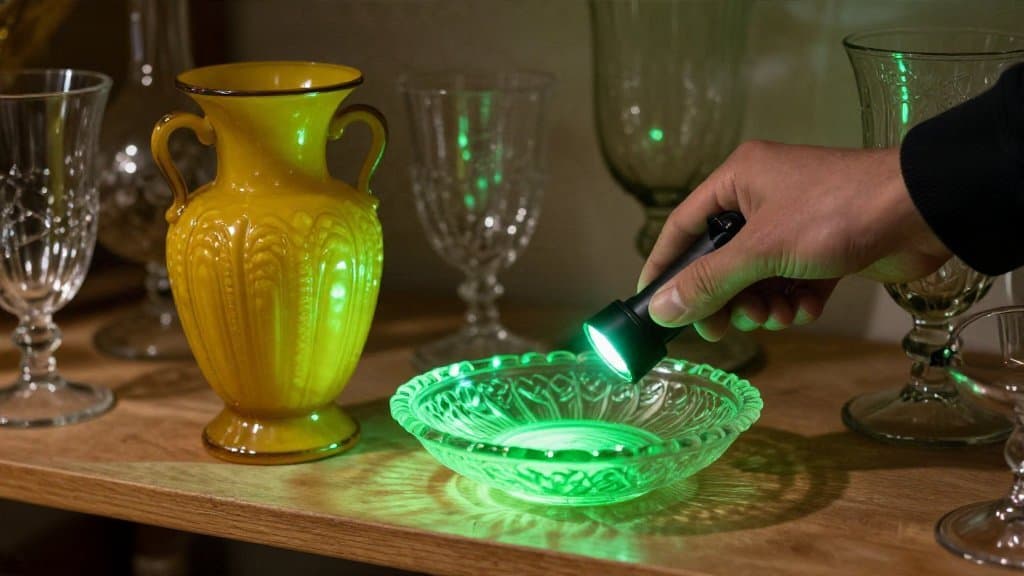
That green glass glowing under your blacklight won't hurt you on a shelf. If you've been wondering is uranium glass safe to buy, keep and resell, the federal measurements are reassuring: a decorative piece gives off less gamma radiation at a foot away than the natural background you're already standing in.
The one firm rule is food. The EPA says not to eat or drink from it, because a chip can put uranium particles in your meal. So buy the canary yellow bud vase, display it, flip it, and leave the radioactive glass out of the kitchen. Here's what the numbers say and what these pieces actually sell for.
What is uranium glass, and why does it glow?
It's ordinary glass with uranium oxide stirred into the batch for color, usually around 2% by weight according to the Oak Ridge Associated Universities health physics museum. Some early 1900s pieces went as high as 25%. Under ultraviolet light the uranium fluoresces, which is why collectors call it the glass that glows green.
Bohemian glassmaker Franz Xaver Riedel was producing it by the 1830s and named his yellow and green shades after his daughter Anna. American production stopped in 1942 when the government took uranium for the Manhattan Project. When makers like Fenton and Mosser started again around 1958 and 1959, they switched to depleted uranium.
Vaseline, custard, jadite and the naming mess
Collectors reserve vaseline glass for the transparent yellow green color that looks like petroleum jelly. Custard is the opaque pale yellow, jadite the opaque pale green, and Burmese shades from pink to yellow. Those names describe looks, not chemistry, so a jadite bowl may contain no uranium at all.
- •Vaseline: see-through yellow green, the classic glowing color
- •Custard: milky pale yellow, often on lamps and pressed bowls
- •Jadite: opaque pale green kitchenware, glow varies by maker
- •Burmese: opaque glass blending from soft pink into yellow
Using a UV flashlight for uranium glass while you shop
Color alone fools people. Oak Ridge notes that yellow glass colored with cerium can look identical, and some vintage yellow was colored with cadmium, which won't fluoresce. The blacklight settles it in two seconds, and most thrift stores won't blink if you shine one at a shelf.
Which wavelength works best?
A 365nm torch is the one most identification guides recommend, because it gives a clean, strong reaction without the purple wash of cheaper 395nm lights. Either will make the real thing light up, though the 365nm beam makes weak glows easier to read in a bright store.
- •Shine the light at an angle and watch for a bright neon green
- •Check thick bases and handles, where the glow is strongest
- •Compare against a known clear glass to rule out reflection
- •Test jadite and custard every time, since many don't react
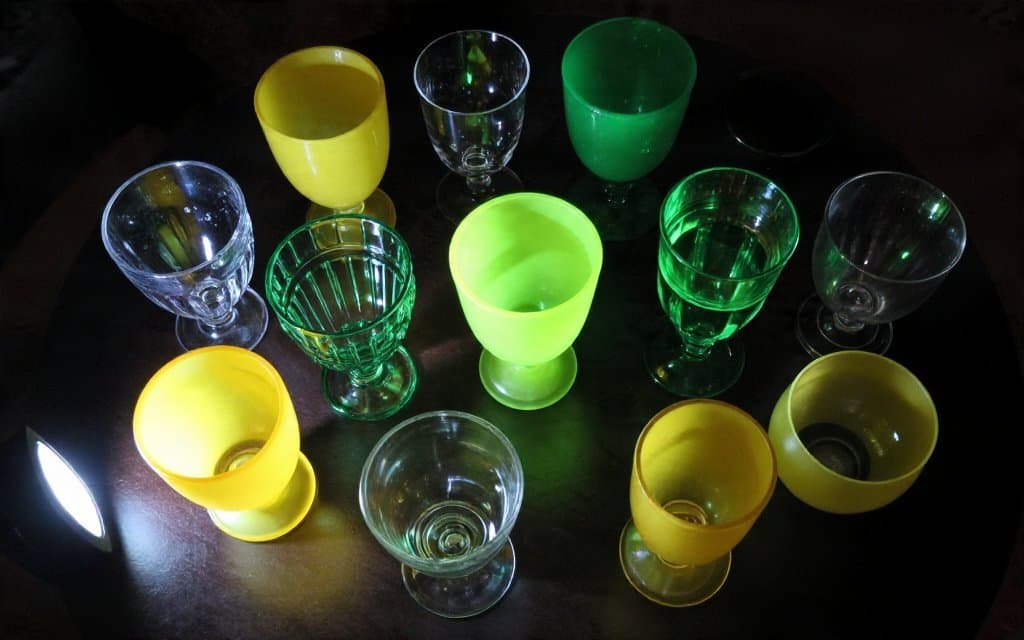
A uranium glass blacklight test proves uranium, not age. Fenton, Mosser, Boyd and Summit were all still making glowing decorative pieces as of 2004.
Is uranium glass safe to keep on a shelf?
Yes, by a wide margin. The Nuclear Regulatory Commission's NUREG-1717 study modeled glass containing 10% uranium, several times a normal piece. It found a gamma rate at one foot from a decorative piece of 0.0018 mrem per hour, against a typical natural background of about 0.01 mrem per hour.
| Situation | Gamma rate | Context |
|---|---|---|
| Drinking glass, 1 ft away | 0.0009 mrem/hr | About a tenth of normal background |
| Decorative piece, 1 ft away | 0.0018 mrem/hr | Under a fifth of normal background |
| Decorative piece, 3 ft away | 0.0002 mrem/hr | Barely registers against background |
| Natural background | 0.01 mrem/hr | What you get anywhere, every hour |
The most exposed people in that study weren't collectors at all. Workers trucking cartons of glassware from factory to warehouse topped out at 4 mrem a year, roughly 1% to 2% of what the average American gets annually. Federal rules exempt glassware with up to 10% source material for exactly this reason.
So why does a Geiger counter click?
Held right against the glass, a sensitive counter picks up beta particles, which barely travel through air. The same study measured 27 mrad per hour on skin at contact but just 1.1 at one foot. Holding a vase for a minute is fine. Wearing a uranium bead against your skin all day is a different question.
Why vaseline glass plates belong in the cabinet, not on the table
Food is where the answer changes. A 1992 study by Landa and Councell soaked uranium glassware for 24 hours and found it leached an average of 0.052 micrograms per liter into water but 5.9 into acetic acid, with one piece hitting 30.1. Vinegar, citrus and tomato sauce are exactly the acidic foods that pull more out.
The EPA's guidance on radioactive antiques is blunt: don't use vaseline glass or old orange red Fiestaware to hold food or drink. Intact pieces are usually not a risk, but chips happen, and a swallowed fleck is a dose you didn't need.
Display it, photograph it, sell it. Just don't serve lemonade in it. That one habit covers almost all of the real risk.
What uranium glass value looks like in sold prices
Most of it is a modest flip, not a jackpot. Ordinary green swung bud vases, the piece you'll see most often, sold for a median of $35 across 86 eBay sales tracked through August 2026, with a low of $15.25 and a high of $225. Median asking price was $39.97, so buyers paid about 14% under ask.
| Era | Typical range | Notes |
|---|---|---|
| Pre-1900 European | $150 to $1,500+ | Bohemian and early English art glass |
| American 1880s-1920s | $75 to $500 | Northwood, Fenton, Cambridge pressed glass |
| 1930s and 1940s | $50 to $300 | Depression era kitchen and table pieces |
| Post-1958 | $30 to $200 | Depleted uranium, often Fenton or Mosser |
Run the maths before you pay. On that $35 bud vase, roughly $30.24 is left after eBay's selling fee, before shipping and your purchase price. At a $5 thrift tag you're netting around $25 a piece, which is solid for a shelf item. Our breakdown of eBay fees on thrift flips shows how fast that margin shrinks on cheaper finds.
- •Pay under $8 for common post-1958 vases and candy dishes
- •Stretch for pre-1920 pressed patterns and signed makers
- •Skip chipped rims unless the pattern is rare or early
- •Bundle small pieces, since $15 sales barely cover shipping
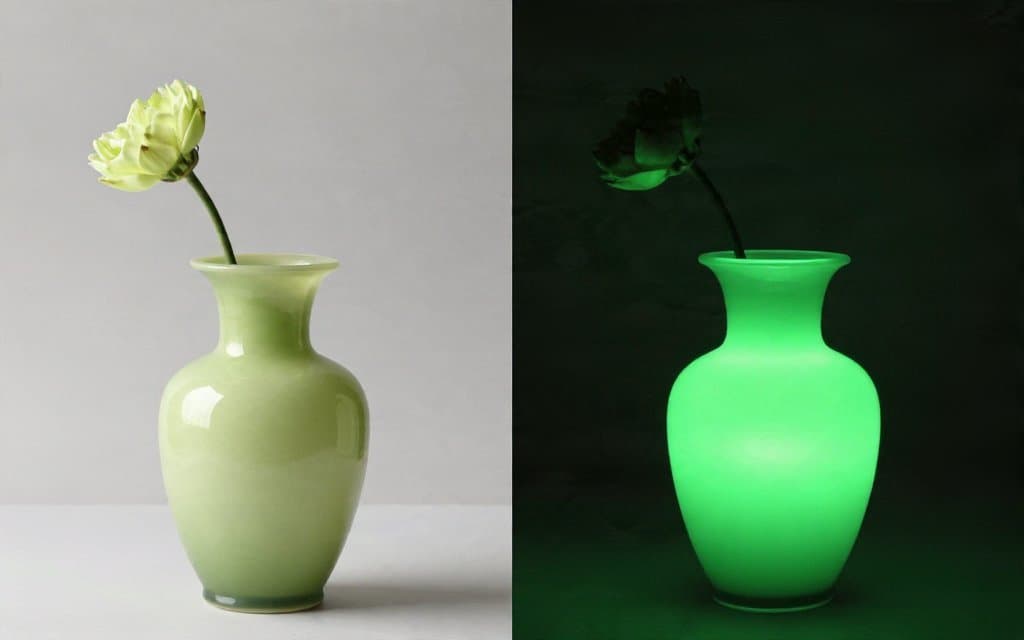
Photos that sell glowing glass
Shoot two images of every piece, one in daylight and one under the blacklight in a dark room. Buyers want proof of the glow, and the contrast shot is what stops the scroll. Mention the wavelength you used so serious collectors can compare it to their own.
Mistakes that cost thrifters money on radioactive glass
The expensive errors are about identification, not radiation. Green Depression glass and jadite get lumped in with the glowing stuff all the time, and a seller who claims uranium without testing invites returns. If you're sorting older green and pink tableware, our guide to spotting depression glass reproductions helps separate the old from the new.
- •Listing jadite as uranium without a blacklight check
- •Paying vintage prices for 2000s Fenton and Mosser pieces
- •Calling every yellow piece vaseline when it may be cadmium
- •Hiding chips that buyers will find under UV light anyway
Maker marks help with that second mistake. A logo on a glowing hobnail bowl often points to a later production run, and our notes on Fenton glass marks and Fire King jadeite marks show how to read them.
Buckley and colleagues estimated at least 4,160,000 decorative pieces were made in the US between 1958 and 1978. Glowing alone doesn't make it rare.
Common questions about glowing glass
Is uranium glass dangerous to touch?
No. Handling a piece while you shop, wash or photograph it gives a trivial dose, since beta radiation drops off sharply within inches. Wash your hands after handling broken or dusty pieces, as you would with any old glass.
Can you drink from uranium glassware?
The EPA says don't, and the leaching data backs that up, especially for acidic drinks. Around 15,000 uranium drinking glasses were made in the US between 1968 and 1972, so you'll find them, but treat them as display pieces.
Is uranium glass dangerous if it breaks?
A broken piece is mainly a cut hazard, but don't grind it, sand it or keep the shards. The EPA suggests calling your state or local radiation control program for disposal instructions, which takes one phone call.
Does all vaseline glass glow under a blacklight?
Nearly all of it does, but not every piece. Oak Ridge notes that some of it, such as yellow gemstone glass, doesn't fluoresce, and in the UK and Australia the word vaseline gets applied to translucent glass with no uranium at all.
Ready to stop guessing about that glowing shelf find? Download Thrift Scanner, snap a photo, and see what similar glass actually sold for before you pay, or browse more tips at thrifting.app. Get the app here: iOS or Android.