


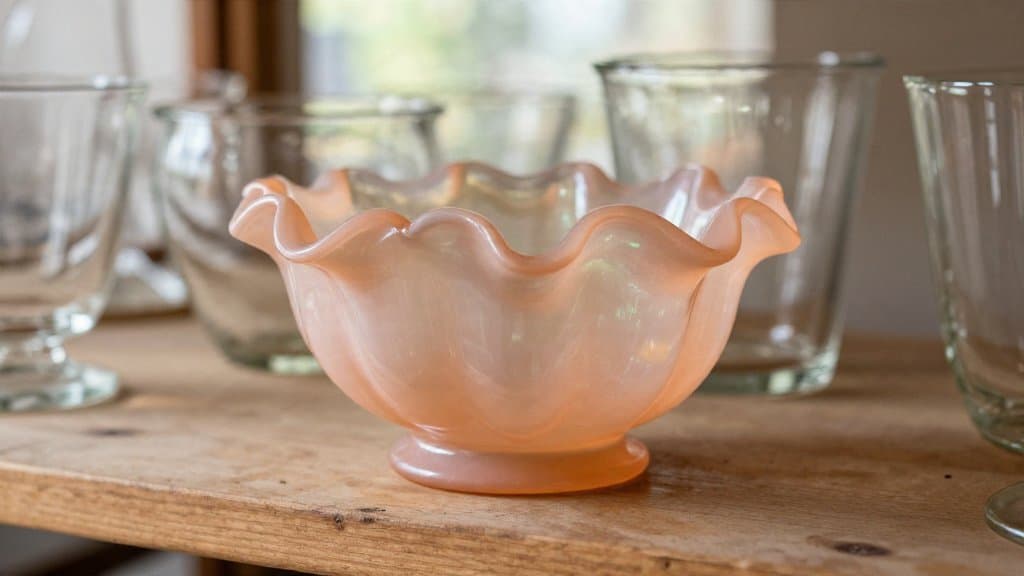
Flip a classic carnival bowl over at the thrift store and you'll usually find nothing on the base. That blank glass is a good sign. Most American carnival made in the classic years, roughly 1907 to 1925, left the factory with no maker's mark at all.
That goes double for Dugan carnival glass, pressed and iridized in Indiana, Pennsylvania, until a fire destroyed the plant in 1931. So when a piece wears a crisp molded logo, you're more often holding a later reissue than a rare signed antique, and the price you can ask drops with it.
Why Dugan almost never marked its carnival
Dugan ran the plant from 1904 to 1913, and the works carried on as Diamond Glass from 1913 until the fire on June 27, 1931. Collectors lump the two together as Dugan-Diamond, partly because both firms used the same factory, which makes it hard to say which one made a given pattern.
According to a collector guide to makers' marks, Dugan usually didn't mark its carnival at all. Its Diamond D trademark turns up on some of its plain pressed glass. The notable exception is the base of a white Wreathed Cherry butter dish.
There's one oddity worth knowing. A few rare Dugan Nautilus pieces carry a Northwood script signature, because Northwood made that shape first in non-iridized glass and Dugan kept using the mould before removing the mark. Collectors pay for that quirk, but it's no reason to trust every script signature you see.
A blank base on a carnival bowl is normal. Millersburg, Dugan, classic Fenton and most Imperial carnival were never trademarked, so a missing mark tells you nothing bad about age.
Northwood's N and the other marks you'll actually see
Northwood is the big exception to the unmarked rule. Its classic mark is a molded N, underlined and set inside a circle, usually on the inside of the piece. Light moulding can make the circle hard to see, and not every Northwood item got one.
A Fenton logo means Revival era
Fenton started the whole category with its Iridill line in 1908 and is credited with more than 150 patterns, yet it never signed its classic carnival. Any Fenton carnival piece bearing the word Fenton or a cursive F comes from the Revival years, about the 1970s through the mid-2000s. The company closed in 2007.
Imperial's IG and the Iron Cross
Most Imperial carnival is unmarked too. A small number of patterns carry an Iron Cross mark from around 1917, while Revival pieces carry the initials IG, LIG or ALIG on the base.
| Maker | Classic mark | Later mark |
|---|---|---|
| Northwood | Underlined N inside a circle | Wonky or partial-circle N on 1970s copies |
| Fenton | None on classic pieces | Fenton script or cursive F, 1970s to mid-2000s |
| Imperial | Mostly none; Iron Cross from c. 1917 | IG, LIG or ALIG |
| Dugan-Diamond | Usually none; Diamond D is rare | No reliable mark, so check the mould |
| Millersburg | None (closed in 1911) | Not applicable |
How to spot fake carnival glass before you pay
Fake carnival leans on the one mark buyers trust. Far East copies of Grape and Cable, Good Luck and Peacocks bowls carry a big, thick capital N with no circle and no underline, and once you've seen a real one, it's the quickest giveaway there is.
Not every bad N is a Far East copy
Some American reissues borrowed the N too. A wonky N shows up on some 1970s Revival items made for L G Wright, and Mosser put a partial-circle N on pastel Grape Delight nut bowls and Grape and Cable butter dishes in the same decade.
- •Thick N with no circle or underline points to a Far East copy
- •A wonky N on Revival glass often traces to L G Wright in the 1970s
- •Partial-circle N on a pastel nut bowl suggests a Mosser piece
- •Fenton script or a cursive F means Revival, not classic
- •IG, LIG or ALIG on the base means Revival Imperial
Shine and old moulds both fool people
Don't lean on brightness. Millersburg's Radium carnival and plenty of Imperial were very shiny from the start, so a glossy finish doesn't prove a piece is modern.
Old moulds are the harder trap. Mosser made a Dahlia pitcher from the original Dugan-Diamond mould, Summit worked with old Westmoreland moulds, and Fenton reissued Butterfly and Berry for Levay using its old Fenton carnival glass tumbler mould. The pattern can be perfect while the piece is decades younger.
A perfect pattern proves nothing on its own. Reissues pressed in original moulds share every leaf and berry with the antique, so check the mark, the colour and the shape together.
What a reissue does to Dugan carnival glass value
Here's where it hits your wallet. Appraisily's color table puts marigold carnival glass bowls and other marigold pieces at about $20 to $100, peach opalescent at $150 to more than $2,000, and white at $500 to more than $5,000. Those top numbers belong to classic pieces in good shape, not Revival ones.
Color inside a single pattern moves the price as much as age does. Antique Trader reported a Northwood Good Luck bowl in amethyst selling on eBay in 2024 for under $60 on a best offer, while ice blue examples of the same bowl went for $150 to $200.
| Piece | Color | Sold price |
|---|---|---|
| Good Luck bowl | Amethyst | Under $60 (2024) |
| Good Luck bowl | Ice blue | $150 to $200 (2024) |
| Nautilus | Peach opal | $25 to $100 |
| Fruit Salad punch set | Peach opal | $1,900 (2014) |
| Grape and Cable bonbon | Peach opal | $13,000 (2014) |
Damage does the rest. Appraisily also warns that even minor damage can cut value by 50% or more, so a chipped classic bowl can end up at Revival money anyway. Count your selling costs too, because eBay fees take a real bite out of a $40 flip.
Price the mark first, then the colour, then the chips. A Revival logo caps the upside long before condition gets a vote.
Peach opal is where Dugan-Diamond earns its name
If one color points straight to Indiana, Pennsylvania, it's peach opal. Research by Bill Heacock, cited by the ICGA collectors club, credits Dugan-Diamond with about 90% of all peach opal carnival. Fenton and Westmoreland made only small amounts.
- •Ski Star and Apple Blossom Twigs are common peach opal patterns
- •Fanciful, Caroline and Petal and Fan also turn up in peach opal
- •Double Stem Rose and Cherries bowls came from Dugan-Diamond
- •Fenton's Dragon and Lotus is a scarcer find in peach opal
Those peach carnival glass flower patterns and fruit designs are worth memorizing. A peach opal bowl with a milky edge is easy to walk past when it's sitting among modern iridescent decor.
Why peach opal is easy to miss
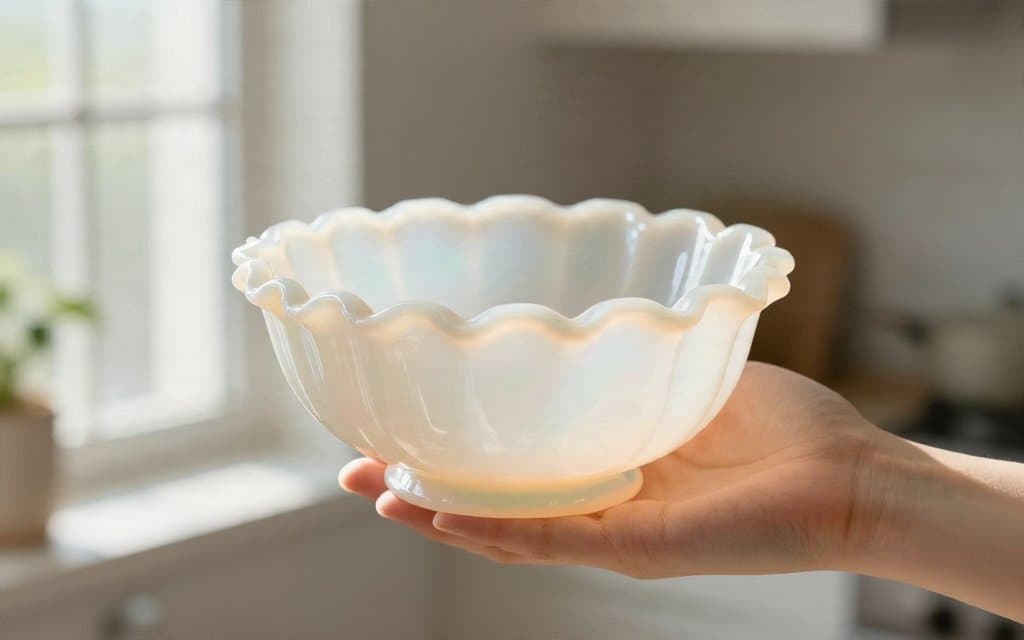
Peach opal is clear opalescent glass given the same iridizing treatment that produces marigold, so from above it can read as plain marigold. Tilt it toward the light and look at the rim, where the milky opalescent band shows through.
A thrift store checklist before you buy carnival
Most of this takes 30 seconds at the shelf. Work through it before the piece goes in your cart, and if you can't place the pattern, an AI resale scanner can pull up sold comps from a photo.
- 1.Flip it and check the base and the inside for any molded mark
- 2.Match any N to the underlined, circled version Northwood used
- 3.Treat a Fenton script, cursive F or IG as a Revival-era piece
- 4.Hold the rim to the light to read the base color under the shine
- 5.Run a finger along the edge and foot to feel for flakes and chips
- 6.Look up sold prices for that exact pattern, color and shape
The same habit works on a tall carnival vase or a stack of marigold carnival bowls: mark first, then color. It carries over to other pressed glass as well, from Fenton hobnail milk glass to depression glass colors and Murano art glass.
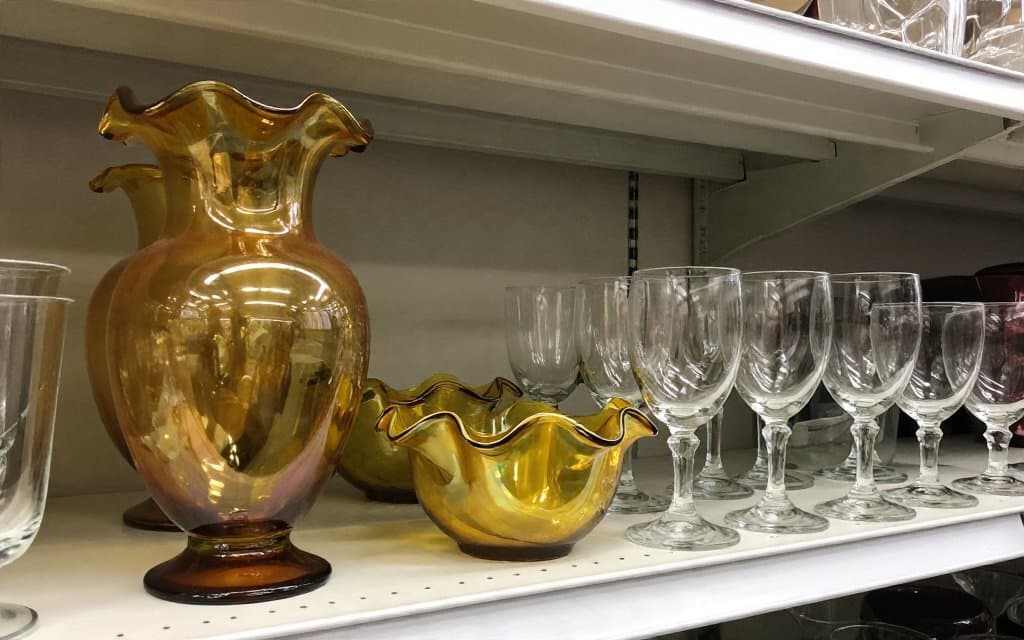
How to Identify and Value Antique Colored Carnival Glass
Questions resellers ask about old carnival
Is unmarked carnival worth anything?
Often, yes. Classic American carnival from Dugan, Millersburg, Fenton and most of Imperial was never trademarked, so value comes from pattern, color, shape and condition rather than a stamp.
Is Fenton white carnival glass old?
If it carries the Fenton name or a cursive F, it dates from the Revival years, roughly the 1970s to the mid-2000s. Price it against other Revival pieces, not against classic white, which can reach $500 or more.
How do I know if a Northwood carnival piece is real?
Look for an N that's underlined and enclosed in a circle, usually inside the piece, and remember light moulding can make the circle faint. A heavy N with neither feature on a Grape and Cable, Good Luck or Peacocks bowl points to a Far East fake.
Ready to stop guessing at the bottom of every iridescent bowl? Download Thrift Scanner, snap a photo of the piece, and see real sold prices before you pay. Get the app here: iOS or Android.