


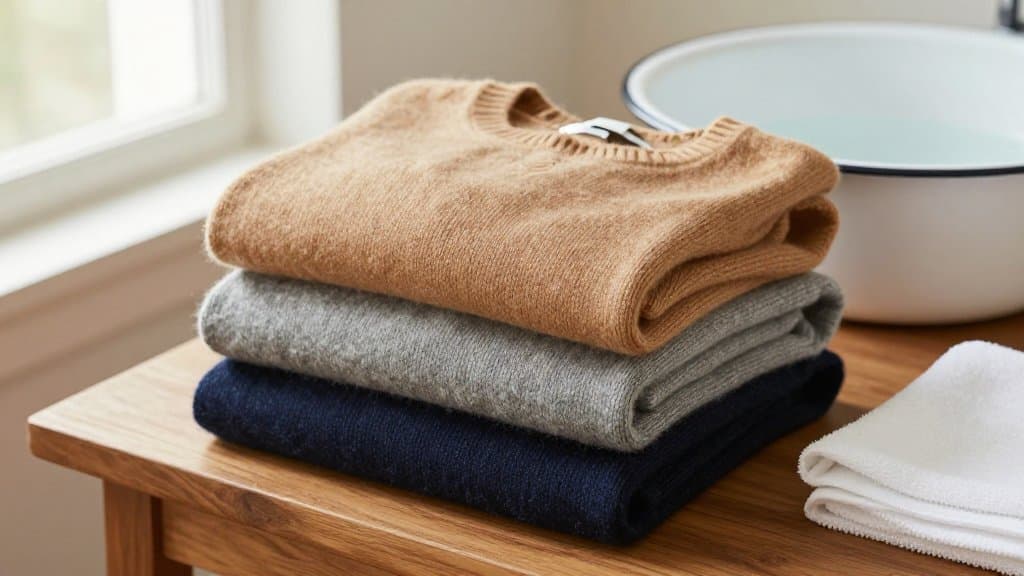
A thrifted cashmere sweater is one of the few knits that can turn three dollars into forty-five without any special knowledge of brands. The catch is condition. Buyers pay for softness, and a sweater that smells like a donation bin or arrives pilled and stiff gets returned or lowballed.
That's why learning how to wash cashmere at home matters as much as spotting it on the rack. A careful hand wash takes a little wool detergent and some patience, and it's often the difference between a lowball offer and a full-price sale. Below is the whole routine: confirming the fiber, cleaning it safely, and doing the money maths before you buy.
What is cashmere wool made of, and where does it come from?
Cashmere is the fine, dehaired undercoat of the cashmere goat, Capra hircus laniger. The name is an anglicized spelling of Kashmir, picked up when Kashmir shawls reached Europe in the 19th century. Today the raw fiber mostly comes from China, which produced 19,200 metric tons in 2016, and Mongolia, which produced 8,900 tons the same year, according to Wikipedia's cashmere wool entry.
The scarcity explains the price. One goat yields an estimated 150 grams of cashmere a year, about a third of a pound. That's why a full-price new knit costs what it does, and why secondhand buyers will still pay real money for one in good shape.

The legal definition behind a 100% label
In the US, a garment can't legally be sold as cashmere unless the fiber meets specific limits set under the Wool Products Labeling Act. Goat fiber that fails those limits has to be labeled as wool instead, which is worth knowing when a tag says something vague.
| Spec | Legal limit | What it means |
|---|---|---|
| Fiber source | Cashmere goat undercoat | Only dehaired undercoat of Capra hircus laniger counts |
| Average diameter | 19 microns or less | Fibers must be very fine to carry the name |
| Coarse fibers | 3% max over 30 microns | Scratchy guard hair has to be combed out |
| Variation | 24% or less | Fiber diameter must stay consistent around the mean |
Is cashmere wool, technically?
Loosely, yes. Shoppers and many labels call it cashmere wool because it's an animal hair fiber spun like sheep's wool. Legally it's its own category, and it's the micron limits above that separate it from ordinary goat hair or lambswool.
Cashmere vs wool vs acrylic on the thrift rack
You won't have a microscope in the aisle, so stack small clues instead. Read the fiber tag first, then trust your hands. Real cashmere feels soft and warm without the slippery sheen of acrylic, and it springs back after a gentle stretch.
- •Look for 100% cashmere on the fiber tag, not cashmere feel
- •Hold it to a window: very see-through knits are thin or blended
- •Real cashmere has a matte surface, acrylic often looks shiny
- •Stretch a cuff gently and check it bounces back to shape
- •Check sleeves, cuffs and underarms for moth nibbles first

Rule of thumb from the bins: read the fiber tag before you fall for the color. A plain grey crew that says 100% cashmere beats a gorgeous blend every time.
Where blends fool people
Cashmere and wool blends, and cashmere and silk blends, are real fibers but resell for less than pure cashmere. Read the percentage. A tag that says 10% cashmere is mostly something else, so price it like a wool sweater. If you're unsure about an older label, the same habit that helps with dating Pendleton wool shirts by their tags works here: the tag tells you more than the fabric.
How to wash cashmere before you list it
Most thrifted knits need a refresh before photos. Hand washing is the safest route, and the method below follows the care guidance in Care of Carl's cashmere washing guide. Always check the care label first, since a few knits are lined or trimmed in fabrics that need different handling.
- 1.Fill a clean basin with lukewarm water, never hot
- 2.Add a mild wool detergent, skip regular detergent and softener
- 3.Submerge the sweater and work it gently, no scrubbing
- 4.Change the water if it turns cloudy or dirty
- 5.Rinse in clean water until no soap remains
- 6.Roll it in a towel and press out water, don't wring it
- 7.Lay it flat on a towel or rack, reshape, keep away from heat

How to clean cashmere that just smells stale
Not every sweater needs a full cashmere wash. If it only smells a little musty, airing it outside for a couple of hours can be enough, and small marks can often be spot cleaned. Fewer washes mean less wear, which keeps the hand feel buyers pay for.
How To Wash Cashmere - Real Simple
Drying and storing between sale and shipping
Never hang a wet knit. The weight of the water stretches the shoulders and the body grows longer. Once it's dry, store it folded flat on a shelf or in a box rather than on a hanger, so it ships in the same shape it was photographed in.
Hot water and dryer heat are what wreck a cashmere sweater. Keep it lukewarm, keep it out of the dryer and away from radiators, and a gentle hand wash is low risk.
What a cashmere sweater flip is worth after fees
Here's where the effort pays. According to the reseller site Thrift Guide, a no-name cashmere sweater can still sell for $30 to $50, and a $3 sweater might sell for $45. Fees decide what lands in your account, so run the numbers before you list.
| Platform | Fee rate | You keep |
|---|---|---|
| eBay | About 13% | About $39.15 of a $45 sale |
| Poshmark | 20% | $36.00 of a $45 sale |
| Depop | 10% | $40.50 of a $45 sale |

Take a $3 buy and the Poshmark column and you're left with $33 before shipping supplies. That lines up with how working resellers think. Arizona reseller Jyl Padgett aims to profit at least $30 to $40 on every item, which adds up to about $1,000 a month for her, and one vintage cashmere piece she thrifted was later listed in her Poshmark closet for $170.
- •Aim for buys near $3 on plain no-name cashmere knits
- •Expect $30 to $50 for a no-name sweater after a good wash
- •Budget 10% to 20% of the sale price for platform fees
- •Pass on shrunken, felted or heavily moth-eaten knits
A $3 sweater that sells for $45 on Poshmark still leaves $36 after the 20% fee. That margin disappears fast if the buyer returns it for pilling or a smell.
Labels that make a vintage cashmere sweater worth more
Brand still moves the ceiling. Scottish mills have spun cashmere for a long time, and Johnstons of Elgin began working with it in 1851, so heritage Scottish labels are worth a second look. Resellers also watch for Pringle of Scotland and Loro Piana, which collectors seek out.
The upside can be dramatic. A shopper paid 8 euros, about $9, for a Brora cashmere jumper at a charity shop, then found the brand sells it for about 330 euros new, as Newsweek reported in January 2026. She kept it, but that gap between thrift price and retail is the reason to read every label.
- •Made in Scotland tags often signal heritage mill knits
- •Look up unfamiliar labels before you leave the store
- •Note vintage details like older tag fonts in your listing
- •Photograph the fiber tag and brand tag clearly for buyers
Vintage condition rules are the same as for any old knit. If you've learned to spot single stitch hems on vintage tees, apply the same patience here: check seams, cuffs and the tag together. For sweaters with small holes, our guide to fixing moth holes in cashmere covers which damage is worth repairing.
Cashmere questions resellers ask
Can a cashmere wash at home shrink my sweater?
It can if the water's hot or you agitate it hard. Use lukewarm water, a wool detergent and gentle handling, and dry it flat away from any heat source. Felting and shrinkage from a hot cycle are why some thrifted knits come in a size too small.
What about cashmere and silk blends?
The steps for how to wash cashmere sweater blends depend on the care label, since silk, nylon or lining fabrics can change the rules. When the label allows hand washing, the same lukewarm, gentle routine works. If it says dry clean only and the piece is valuable, don't gamble with it.
Is pilling a sign the sweater is fake?
Not on its own. Real cashmere pills, especially at the underarms and cuffs, and a fabric shaver can tidy it before photos. Heavy pilling on a brand-new looking knit can point to lower grade or blended fiber, so read the tag before you decide.
Should I list a sweater before washing it?
Usually no. A clean, fresh knit photographs softer and avoids not-as-described returns over smell. Wash it, dry it flat, then shoot it in natural light with the fiber tag in frame, the same way you'd document details when checking whether a Coach bag is real.
Ready to stop guessing at the sweater rack? Download Thrift Scanner, snap a photo of a knit and its label, and see real sold prices before you pay. More tips live at thrifting.app. Get the app here: iOS or Android.