


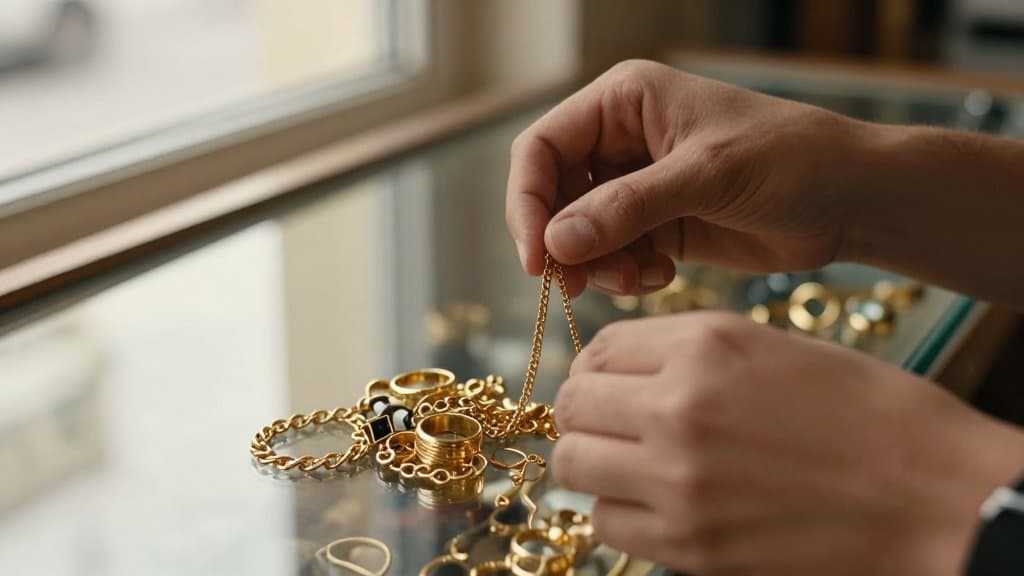
You spot a tangle of gold chains in the case at Goodwill, priced at four dollars for the lot. The clasp is warm and heavier than it looks. Before you hand over cash, you want a fast way to tell if gold is real, because most of what sits in that case is plated brass. Knowing how to tell if gold is real is the difference between a four dollar flip that nets two hundred and a drawer full of green-wristed regret.
Here's the good news. You don't need a lab. A magnet, a glass of water, a jewelers loupe, and thirty seconds reading the stamp will sort solid gold from the fakes most of the time. This guide follows the same order a working reseller uses, from the cheapest check to the acid test, so you know how to tell if gold is real before the person behind you grabs the lot.
Solid gold never sticks to a magnet and never rusts. If a gold chain jumps toward a magnet, the core is steel or brass wearing a thin gold coat.
Read the hallmark stamp first
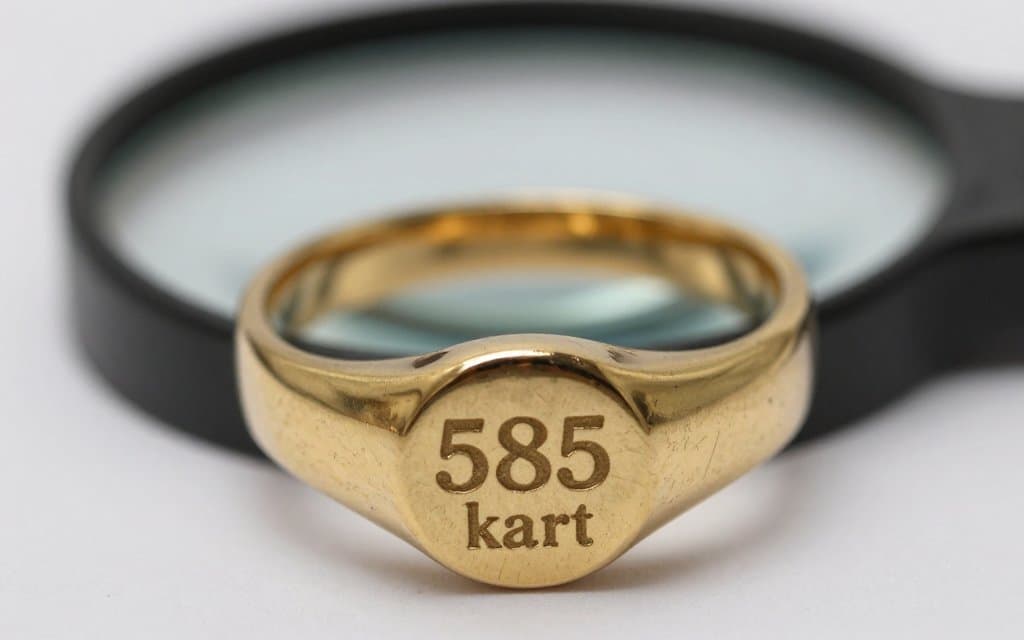
Flip the piece and hunt for tiny numbers on the clasp, inside a ring band, or the back of a pendant. Those stamps are the maker telling you the gold content. In the US you'll usually see karat marks like 10K, 14K, or 18K. Across Europe, the Middle East, and Asia the same thing shows up as a three-digit fineness number such as 585 or 750.
- •Inside a ring band near the lower curve
- •On the clasp or jump ring of a chain
- •The back edge of a pendant or charm
- •The post or clutch back of an earring
- •Under the bail where a locket meets its chain
| Karat stamp | Fineness | Gold content |
|---|---|---|
| 10K | 417 | 41.7% gold |
| 14K | 585 | 58.3% gold |
| 18K | 750 | 75% gold |
| 22K | 916 | 91.6% gold |
| 24K | 999 | 99.9% gold |
So 585 stamped inside a ring means 58.3 percent pure gold, or 14 karat. A 750 means 75 percent, or 18 karat, which carries more gold per gram and sells for more when you weigh it. A stamp is strong evidence, not proof, because counterfeiters stamp brass too. That is why the next checks matter.
Stamps that quietly mean plated
Some marks look like a karat stamp but tell you the piece is coated. GP means gold plated, GF means gold filled, and HGE or 1/20 point to a thin electroplated layer over base metal. Gold filled is worth a little for its bonded gold, but plated and electroplated pieces are costume, no matter how convincing the color. Costume pieces get stamps too, which is why our guide to costume jewelry marks earns a look for the non-gold finds.
How to tell if gold is real with a magnet
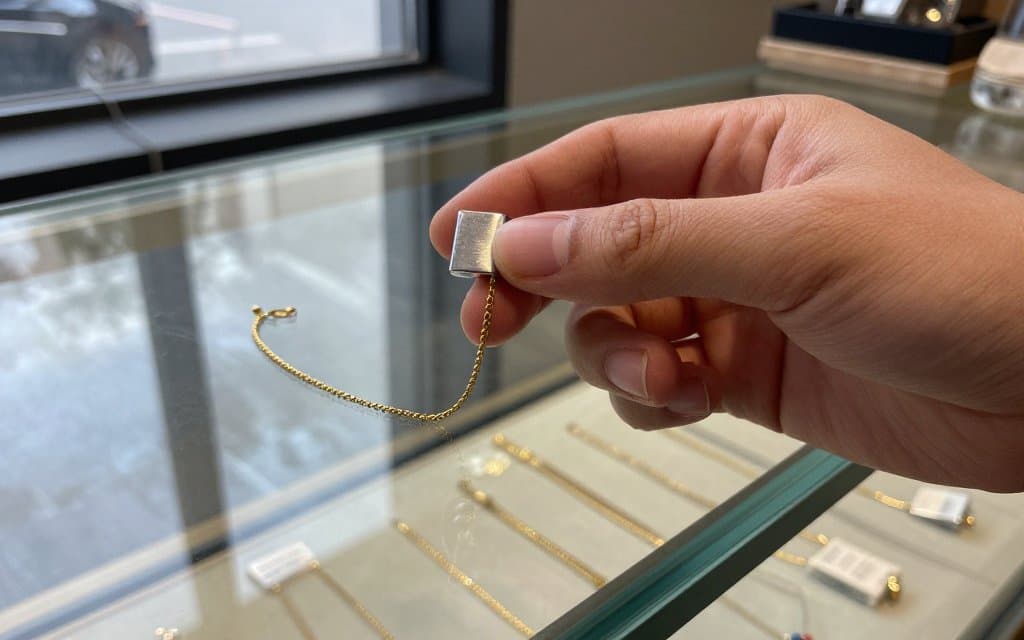
This is the check I run first at the counter. Real gold is not magnetic, so a strong magnet is your quickest lie detector. Hold a neodymium magnet, the kind pulled from an old hard drive, next to the piece. If it pulls, jumps, or drags, the core is iron or steel and the gold is a coating. Ask is gold magnetic, and the honest answer is no, which is exactly why the test works.
A magnet won't catch every fake, though. Brass and copper are not magnetic either, so a plated brass chain can pass this test and still be worthless underneath. Treat a magnet as a fast way to throw out the obvious junk, then keep going down the list.
- •A magnet grabs it, so the core is base metal
- •Green skin after a day points to plated brass
- •Fresh scratches show white or silver beneath
- •It feels too light for its size
Gold is dense, about 19.3 grams per cubic centimeter, nearly three times heavier than the same size lump of iron. Real pieces feel wrong in a good way, oddly heavy for how small they are.
How to test gold at home without damage
Once the magnet clears a piece, you can run a couple of gentle tests at the kitchen sink. The point of learning how to test gold at home is to gain confidence before you buy, not to scratch up something you might resell. Start with the checks that leave no mark at all.
The float and density check
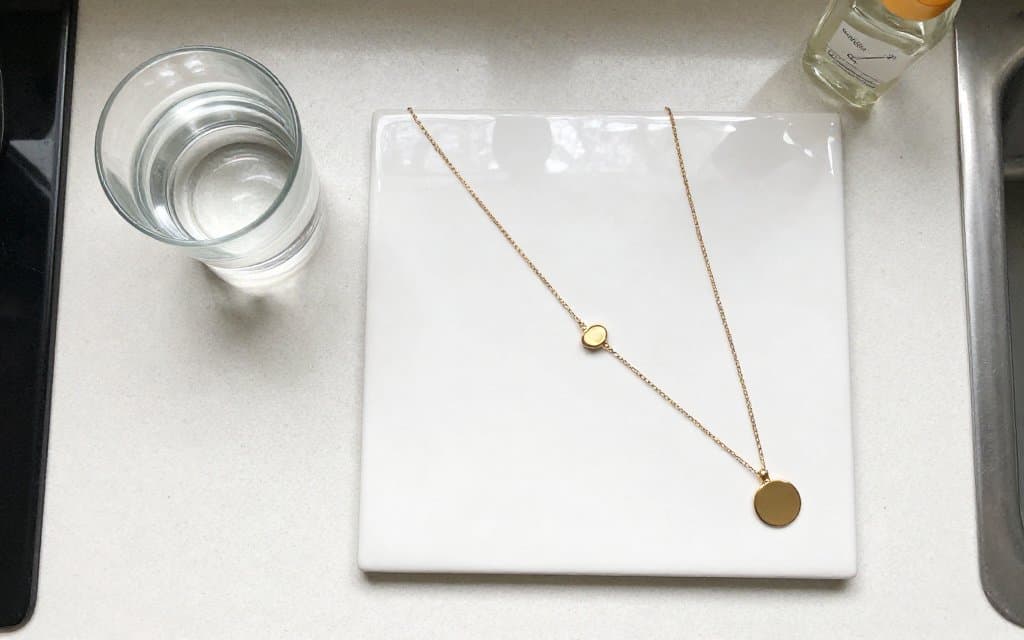
Fill a glass with water and drop the piece in. Because gold sits at 19.3 grams per cubic centimeter, real solid gold sinks fast and lands flat on the bottom. A hollow or plated fake often drifts, tips, or floats a beat. It is not foolproof, since a dense fake can also sink, but a floater is a clear no.
For a light scratch test, drag the piece across an unglazed ceramic tile or the rough underside of a bathroom tile. Real gold leaves a gold streak. Fake gold, or plated metal worn through, leaves a black or gray streak. Do this on a hidden spot, and skip it on anything you would rather sell intact.
- •Water drop, real gold sinks flat and fast
- •Skin test, fakes leave green or black marks
- •Ceramic scratch, real gold streaks gold
- •Vinegar drop, plated metal dulls or spots
The gold acid test, and when to pay a pro
When a stamp and a magnet leave you unsure, a gold acid test settles it. A hobby kit runs about $15-30 and comes with graded acids for 10K, 14K, 18K, and 22K. You make a tiny scratch on a test stone, add a drop of the matching acid, and watch. Real gold at that karat holds its color. If it fizzes away or turns milky, the metal is lower karat or fake.
The whole fake gold vs real gold question usually ends here, because acid reacts with the base metals hiding under a plated surface. The catch is that acid tests take practice, and a careless scratch can wreck a resale piece. For anything that looks valuable or antique, a jeweler with an XRF gun reads the exact karat in seconds without a mark, and most will quote you for free.
| Test | Cost | Verdict |
|---|---|---|
| Magnet | $0 | Rules out iron or steel core |
| Water float | $0 | Real gold sinks flat |
| Ceramic scratch | $0 | Gold streak means gold |
| Acid kit | $15-30 | Confirms 10K to 22K |
| Jeweler XRF | Free quote | Exact karat, no mark |
What thrifted gold is actually worth
Here is where knowing how to tell if jewelry is real gold turns into money. Solid gold sells two ways, for scrap by weight or as a piece someone wants to wear. Scrap sets a floor. A plain 14K chain weighing 8 grams is worth its melt value no matter how plain it looks, and that alone often beats the thrift price by a wide margin.
Karat drives the number. Because 18K is 75 percent gold and 14K is about 58 percent, an 18K piece of the same weight is worth noticeably more melted down. Signed designer gold, older hallmarks, and intact gemstones push the price well above melt. When you find a stamped, magnet-passing piece for a few dollars, the spread between cost and value is the whole game.
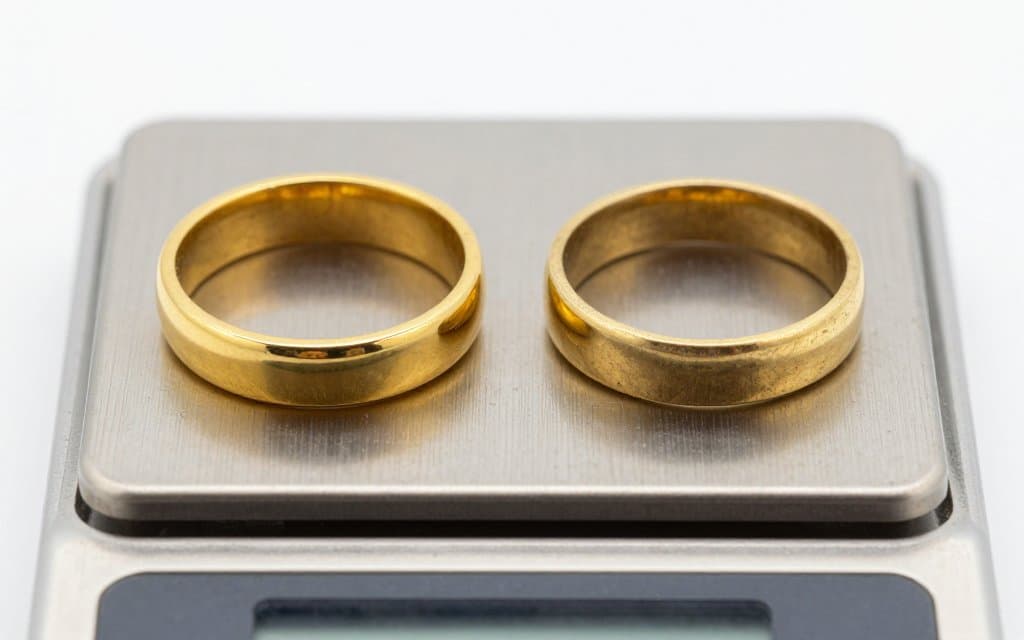
- •A higher karat such as 18K over 10K
- •A designer signature or maker hallmark
- •More gram weight in a solid piece
- •Original stones still set and secure
Silver keeps landing in the same cases, and our guide to sterling silver markings uses the same read-the-stamp habit. The Louis Vuitton authentication checks in the bag aisle rhyme with these. When a stamp is worn off, you can snap a photo and pull recent sold comps before you spend a dime.
Common questions about spotting real gold
How do you know if gold is real without acid?
Stack the no-mark tests. A piece that ignores a strong magnet, sinks flat in water, shows a real karat stamp, and has not left green on anyone's skin is almost certainly solid gold. No single check is proof, but three or four of them agreeing is about as sure as you get without a jeweler.
How can you tell if something is real gold at a glance?
You mostly cannot, and that is the honest answer. Color and shine are easy to fake, which is why plated brass fools people daily. A quick loupe for the karat stamp plus a magnet in your pocket turns a glance into a real read in under a minute.
What does 585 mean on gold?
585 means the piece is 58.5 percent pure gold, the European way of stamping 14 karat. You will also see 375 for 9K, 750 for 18K, and 916 for 22K. If you want to know how to test if gold is real once you spot that stamp, the magnet and acid checks above confirm the number is honest.
Is gold-plated jewelry worth anything?
Rarely for the gold itself, since the coating is measured in microns. A few plated designer or vintage pieces sell for their style, but if you are buying to melt or flip for metal, plated is a pass. Save your cash for the stamped, magnet-passing solid stuff.
Ready to stop guessing in the jewelry case? Thrift Scanner reads the maker, weighs the odds, and pulls real sold prices from a single photo, so you know what a piece is worth before you buy it. Snap it, check the stamp, and never leave real gold behind again. Get the app here: iOS or Android.