


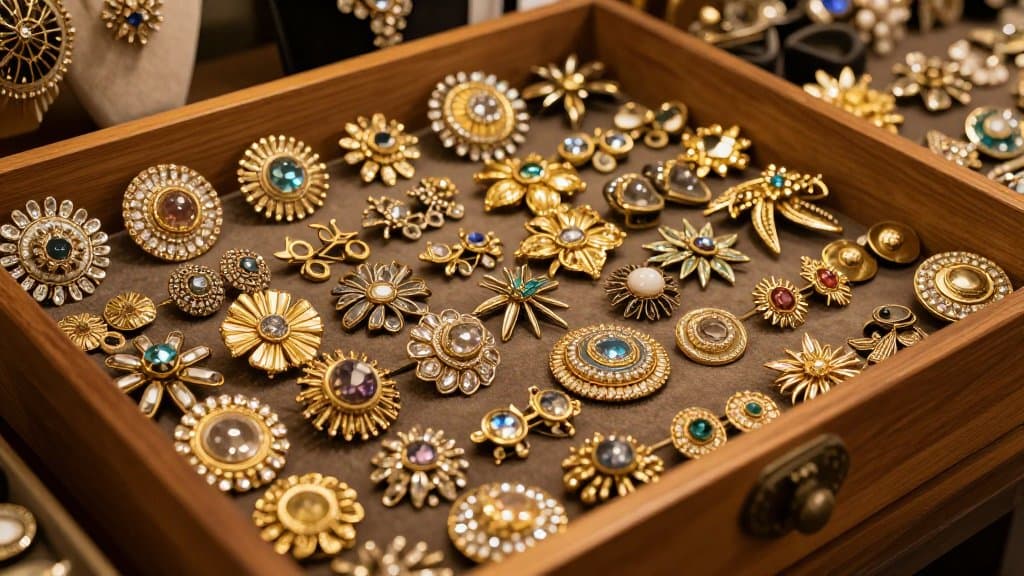
A signed brooch can sit in a thrift store case for two dollars while an identical unsigned one is ignored. The difference is a tiny stamp on the back. Antique costume jewelry brooches are one of the most overlooked profit categories in any thrift store, because most shoppers never turn a piece over to read it.
This guide covers the costume jewelry marks that matter, how to date a piece by its clasp, and what real vintage costume jewelry sells for right now. Every price below comes from documented sales, not guesswork. Read the back first, then decide what to pay.
Where Antique Costume Jewelry Brooches Hide Their Marks
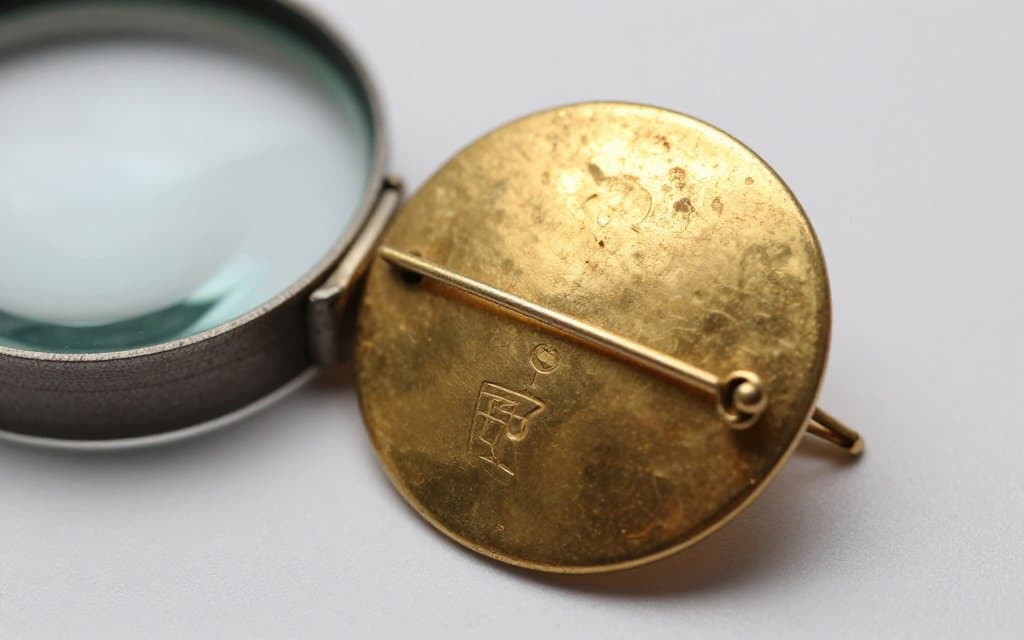
Makers stamped their name where it would not spoil the front of the piece. On a brooch, check the back plate near the pin. On earrings, look at the clip or the flat back. On necklaces and bracelets, the mark usually sits on or beside the clasp. A jeweler's loupe at 10x turns a blurry scratch into a readable signature.
Whole trays of old costume jewelry brooches turn up at estate sales for a dollar or two each, and vintage costume jewelry brooches from the 1940s and 1950s are the resale sweet spot. Antique costume brooches with a readable maker can outpace fine jewelry on margin, since you buy them for pocket change.
Marks are not always a name. Many pieces carry only a patent number, a copyright symbol, or a single letter, and those still date the piece. A copyright symbol next to any mark means the piece was made in 1955 or later, since that symbol was added to jewelry stamps around then. The same read the back habit works for sterling silver markings and for spotting vintage mirror frames that sell high.
- •Back plate of a brooch, next to the pin stem
- •Clip or flat back of clip-on earrings
- •Small tag soldered near a necklace clasp
- •Inside the band on costume rings and cuffs
Reading Trifari Jewelry Marks by Decade
Trifari is the blue chip of American costume jewelry, and its marks read like a timeline. The firm began under the Trifari, Krussman and Fishel name, and its earliest pieces from the late 1920s carry a large KTF stamp. Chief designer Alfred Philippe gave the brand its crown pins and its lasting reputation.
The crown is the key. A crown sitting over the T in the name points to roughly 1939 through 1955. Add a copyright symbol after the crowned name and the piece dates to 1955 through 1969. Later work drops the crown and prints the name in italic script, which signals the 1970s and 1980s, as laid out in this Trifari dating guide.
| Mark | Years | Era clue |
|---|---|---|
| KTF stamp | 1925 to 1930s | Earliest pieces |
| Name plus Pat Pend | 1930s to 1955 | Pre-crown era |
| Crown over T | 1939 to 1955 | Classic crown mark |
| Crown plus copyright | 1955 to 1969 | Golden age |
| Italic script name | 1970s to 1980s | No crown |
Signed pieces from this maker sell well. Everyday examples on eBay commonly bring $12 to $25, while rare designs at auction have reached $600 to $2,000 or more. The famous Fruit Salad fur clips, set with molded glass fruit, have sold for around $5,000.
A copyright symbol beside a crown mark dates a piece to 1955 or later, a five second check that separates the golden age from the reproductions.
Coro, Weiss, and Other Costume Jewelry Marks Worth Knowing
Trifari is not the only name that adds zeros. Coro ran through several identities, from Coro to Corocraft to the upscale Vendome line, and its patented Duette let two matching clips snap onto one frame. A Coro Duette in the Carmen Miranda design once sold for about $1,800 at auction.
Eisenberg, a Chicago maker, signs pieces Eisenberg or with a single E, and its rhinestone figurals run from $15 to $100 for common examples up to $1,675 for a rare Puss in Boots fur clip. Miriam Haskell used a horseshoe cartouche and hand wired faux pearls, and Hattie Carnegie pieces have brought as much as $2,400 for a matched set. The skepticism that helps you spot a fake designer bag applies to signed jewelry too.
- •Coro, Corocraft, or Vendome script signatures
- •Eisenberg name or a lone capital letter E
- •Miriam Haskell horseshoe cartouche tag
- •Weiss signature on bright rhinestone pieces
- •Hattie Carnegie name or a Miss Hattie mark
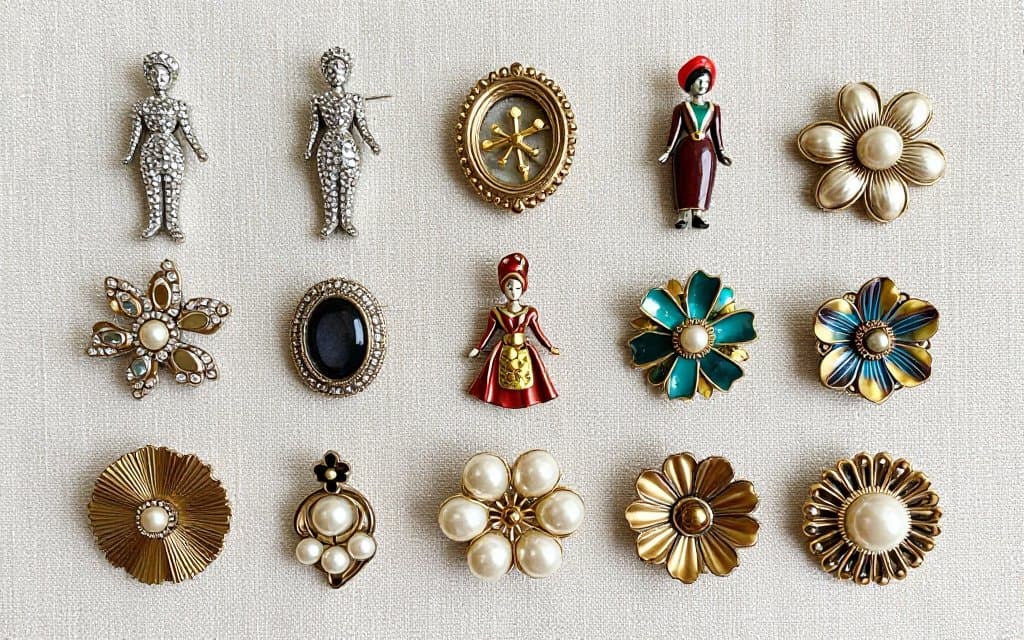
Date a Vintage Costume Brooch by Its Clasp
When a piece has no name at all, the hardware still talks. The clasp on the back of a brooch changed with manufacturing, so it dates the piece even when the signature is worn away. This is the most useful skill for buying unsigned lots at estate sales.
A simple C shaped hook, called a C clasp, was standard from about 1850 to 1910. The tube style trombone clasp appeared in the early 1890s and shows up often on 1940s pieces. The rollover safety catch you still see today became common in the 1920s and 1930s.
| Clasp | Years | Era clue |
|---|---|---|
| C clasp hook | 1850 to 1910 | Victorian era |
| Trombone tube | 1890s to 1940s | Push pull catch |
| Rollover safety catch | 1920s onward | Still standard today |
| Round machine hinge | 1930s onward | Mass produced |
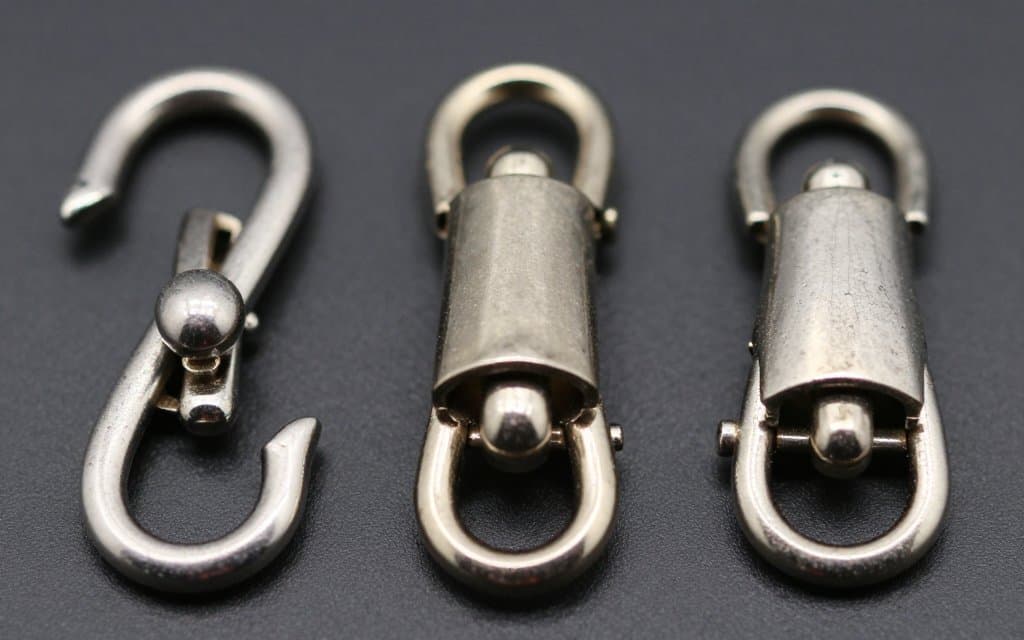
Flip an unsigned brooch over. A C clasp usually means the piece predates 1910, while a rollover safety catch points to the 1920s or later.
Dating Antique Costume Earrings and Rings
Earrings and rings follow the same logic. Antique costume earrings with screw back fittings usually date to the 1890s through the 1930s, before clip backs took over. Clip earrings became common from the 1930s onward, and pierced posts point to later pieces or modern revivals.
Vintage costume rings hide their marks inside the band, so check there and look for adjustable shanks and plated wear. A worn spot that shows a different metal underneath is normal on costume pieces and does not kill the value, but a cracked rhinestone or a missing stone does.
- •Screw back fittings suggest pre 1930s earrings
- •Clip backs point to the 1930s and later
- •Pierced posts read as newer or reissued pieces
- •Adjustable shanks are common on costume rings
What Signed Brooches Are Actually Worth
Costume jewelry value comes down to four things: a known maker, strong condition, complete sets, and desirable design. A signed brooch almost always beats an identical unsigned one, and a matching brooch and earring set beats the brooch alone. Bakelite, enamel figurals, and clean rhinestones move fastest.
Set realistic numbers. Common signed brooches sell in the $15 to $40 range, better designer pieces run $80 to $120, and rare examples cross into the hundreds or thousands. A single Bakelite bangle can bring $100 or more on its own. When you want a fast read, the thrifting.app value tool pulls real sold comps from a photo.
- •A clear maker signature over an unsigned twin
- •Complete brooch and earring sets, not singles
- •Bakelite, enamel, and bright rhinestone work
- •Original condition with every stone present

A signed piece almost always outsells an identical unsigned one, so the mark on the back is often worth more than the metal in the piece.
Common Questions About Costume Jewelry Value
What costume jewelry marks are worth money?
Signed pieces from Trifari, Coro, Eisenberg, Miriam Haskell, and Weiss carry the most reliable value. A maker signature, a patent number, or a copyright symbol all help date and authenticate a piece. Unsigned pieces can still sell, but a clear mark usually adds the most.
How do you date a vintage costume brooch?
Start with the clasp. A C shaped hook points to before 1910, a trombone tube is common on 1940s pieces, and a rollover safety catch means the 1920s or later. Then read any signature, since a copyright symbol dates the piece to 1955 or after.
Are Trifari jewelry pieces valuable?
Yes, especially crown marked designs from 1939 to 1969. Everyday examples bring $12 to $25, but rare pieces reach $600 to $2,000 at auction, and the molded glass Fruit Salad clips have sold near $5,000. Condition and complete sets push prices higher.
Is a leaf Trifari brooch worth anything?
A leaf Trifari brooch is a steady seller rather than a rarity, usually landing in the $20 to $60 range in good condition. Gold tone and pearl leaf designs, along with the popular Trifari butterfly brooch styles, sell quickly because buyers know the look. A crisp crown mark with no missing stones brings the top of that range.
Ready to stop guessing at the thrift store jewelry case? Thrift Scanner reads the marks, checks real sold listings, and shows what an antique costume jewelry brooch is actually worth before you buy. Snap a photo and never overpay again. Get the app here: iOS or Android.