


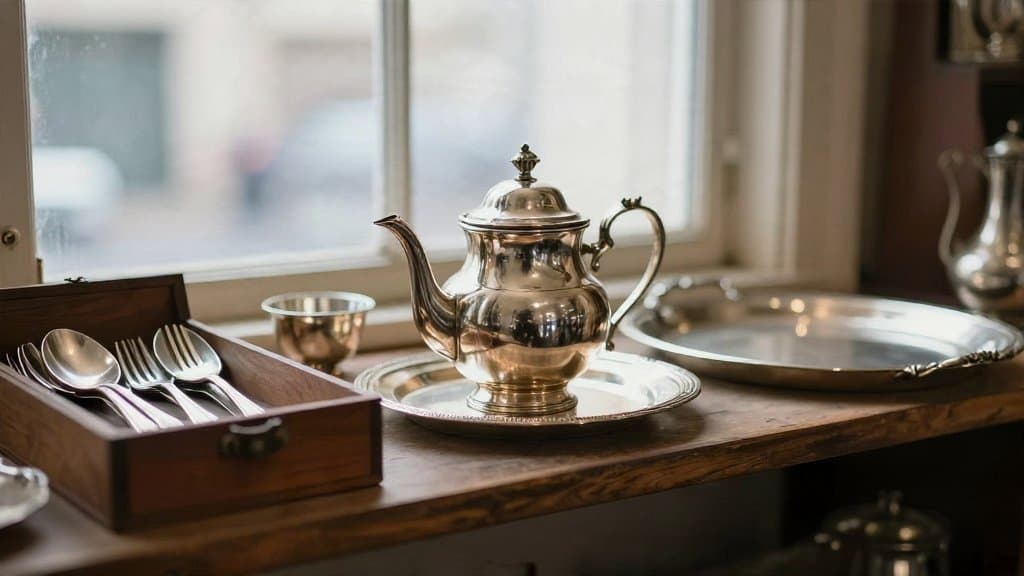
Is silver plate worth anything once you learn the silver on it can't be scrapped for cash? Yes, but usually a few dollars a fork, not a few dollars a gram. Estimonia looked at 230 plated pieces between July and early November 2026, and half of them came in at $30 or less.
Sterling is a different animal. Silver closed out at $49.82 a troy ounce on November 13, 2026, so every ounce of sterling carries about $46.08 of metal because it's 92.5% silver. That melt floor is why the price of sterling silverware rarely drops near thrift store tags, while a plated teaspoon holds well under a dollar of silver.
So the money in plate lives somewhere else: the maker, the form and whether the set is complete. Once you know which pieces clear that bar, the silver aisle stops being a guessing game.
Silver plated vs sterling silver comes down to the metal underneath
Sterling is solid silver alloy all the way through, usually 92.5% silver with copper making up the rest. Plate is a thin skin of real silver electroplated over a cheaper base. That skin is only a few thousandths of a millimetre thick, so no refiner can recover it economically.
The EPNS meaning, plus the other plate codes
EPNS stands for electroplated nickel silver. Despite the name, nickel silver (also sold as German silver) is a copper, nickel and zinc alloy with no silver in it at all. Elkington and Co. of Birmingham held the key early patents on the process in the 1840s, which is why plate took over British and American dining rooms so quickly.
- •EP or EPNS: electroplated, often over nickel silver
- •EPBM: electroplated Britannia metal
- •EPWM and EPGS: plate over white metal or German silver
- •A1, AA or XII: a plater's quality grade, not silver content
- •Quadruple Plate or Triple: a heavier coat, still plate
- •Nickel silver, German silver, Alpaca: no silver at all
Brand names trip people up too. 1847 Rogers Bros., Wm. Rogers, Community, Holmes and Edwards, Harmony House and Godinger are plate unless the word Sterling appears. The 1847 on those spoons is the year the Rogers brand was founded, not the year your spoon was made.
A seller once brought in two Gorham and International Silver sets she believed were sterling. As sterling they would have been worth $750 to $1,500 each. As plate, they were worth about $25 per set.
How to tell if silver is real before you pay
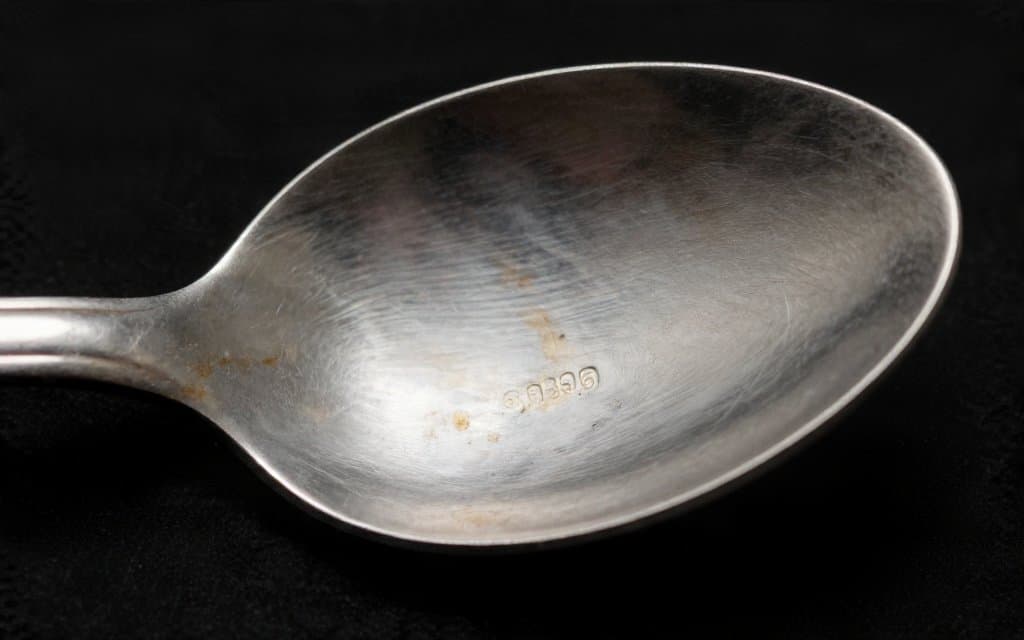
Start with sterling silver marks. American sterling says STERLING or 925, usually on the back of the handle just below the bowl, and knives carry it on the collar where blade meets handle. British sterling uses silver hallmarks instead: a lion passant alongside a town mark and a date letter. No lion and no assay office mark means you're holding plate.
Reading hallmark stamps on silver without guessing
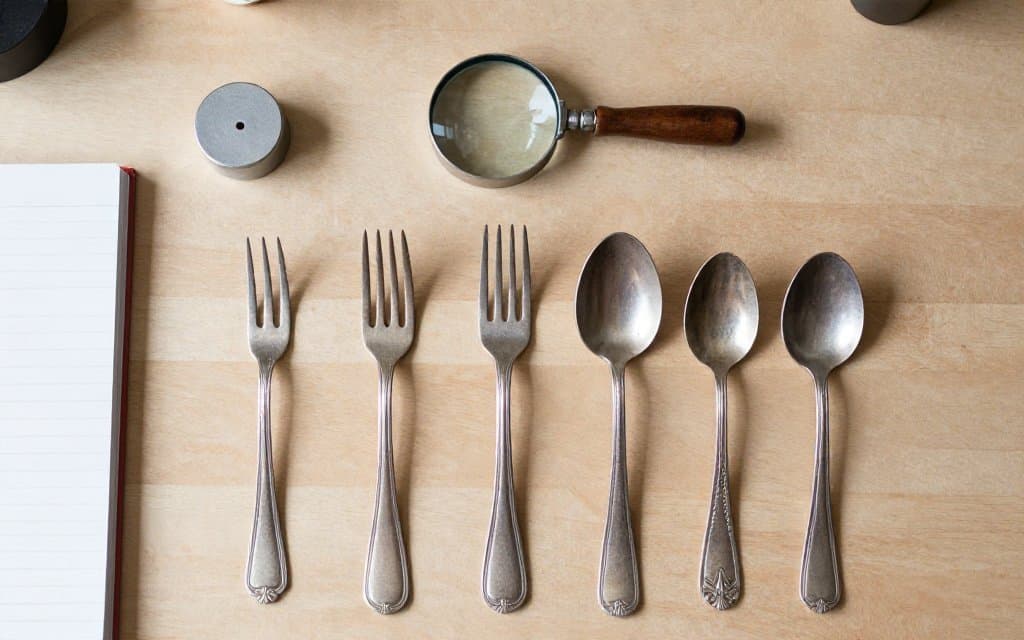
Silver markings are tiny and often half polished away, so carry a loupe and read every symbol before you decide. Be careful with makers: Gorham, Reed and Barton, Wallace and Towle all made both sterling and plate, so the company name alone proves nothing.
| Mark | Meaning | Melt value |
|---|---|---|
| STERLING or 925 | 92.5% silver, American standard | About $46 per troy ounce at $49.82 spot |
| Lion passant | British sterling with town and date marks | Same as sterling, priced by weight |
| EPNS or EP | Silver plated over a base metal | Well under $1 per spoon |
| A1, AA, XII | Plater's grade for a heavier coat | Still negligible |
| Nickel or German silver | Copper, nickel and zinc alloy | Zero silver content |
Quick checks that won't damage a piece
- •A magnet that clings means it's not sterling
- •A clean magnet test doesn't prove sterling either
- •Yellow or copper showing on high points means plate
- •Check knife collars and the back of spoon handles
- •Save acid testing for pieces you're willing to mark
Is it worth anything? Sterling Silver and Silver Plate
If the marks are worn flat, an acid test settles the question, but it leaves a spot. That's fine on a $3 serving spoon and a bad idea on a teapot you hope to sell to a collector.
Is silver plate worth anything when the maker is right?
Most plate sells between $5 and $150, and the forms matter more than the metal. A boxed service sells better than a drawer of loose spoons, and certain names push well past the usual range. Here's what recent valuations and auction results show for common finds.
| Plated item | Typical price | What lifts it |
|---|---|---|
| Single spoon or fork | A few dollars | Serving pieces in popular patterns reach $5 to $25 |
| Boxed service for 8 or 12 | $40 to $150 | Complete count and the original box |
| Tea and coffee set | $50 to $250 | A matching tray adds $20 to $100 |
| Hotel flatware | $5 to $40 each | A clear hotel backstamp |
| Victorian figural napkin ring | $30 to $200 | Crisp figures with no repairs |
| Christofle flatware service | $500 to $2,000+ | Full service in its case |
Christofle and Old Sheffield deserve a second look
Christofle marked its plate with CC and a balance inside a square from 1862 to 1935, then switched to OC. A 120 piece Christofle Port Royal service hammered at $700 in June 2024, and an 84 piece canteen made £950 in February 2023 against a £200 to £300 estimate.
Old Sheffield plate is fused silver on copper, made from about 1743 until electroplating replaced it in the 1840s. Look for copper peeking through, seams and rolled edges. An unmarked Old Sheffield tureen sold for $800 in July 2026, double its $400 high estimate.
Pieces simply stamped Sheffield are usually 20th century electroplate. Real Old Sheffield plate rarely says so, and its copper core shows at worn edges.
The money maths on plate versus sterling
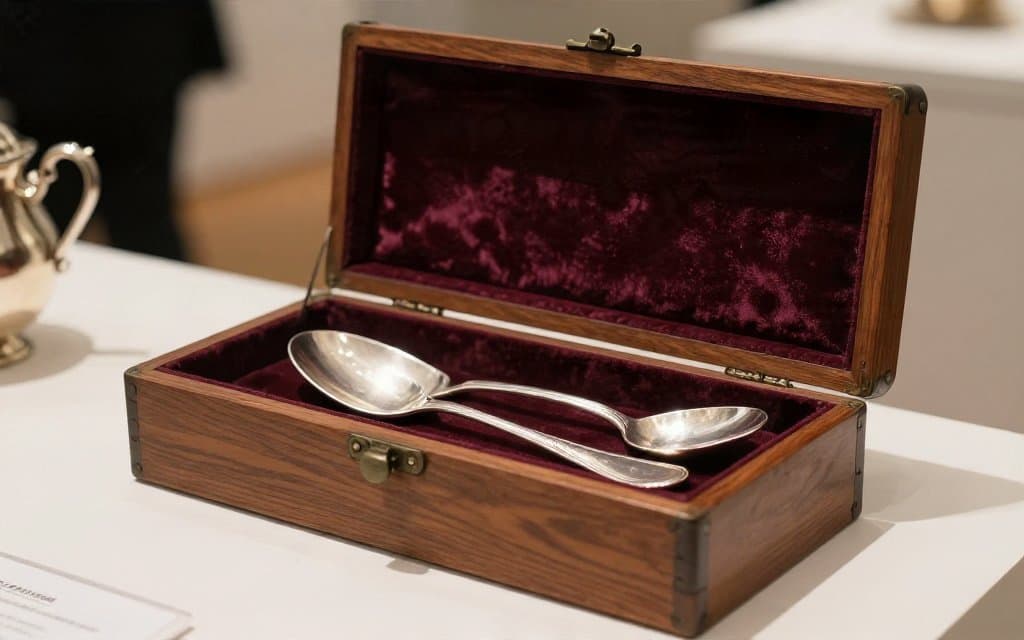
Sterling silverware value per ounce sets a floor no plated piece ever has. A sterling teaspoon weighs about 25 to 35 grams, so a 30 gram spoon holds 27.75 grams of pure silver, worth about $44.45 at $49.82 spot. Scrap and pawn shops pay 60% to 80% of melt, while refiners pay 85% to 95%, so that one spoon fetches roughly $27 to $42 even with a dent.
Plate works on margins instead. Say you pay $10 for a boxed service for 8 and sell it for $40 on eBay. The 13.6% final value fee plus the $0.40 order fee takes $5.84, leaving $34.16 before shipping, so your profit is about $24 less postage and packing. Our breakdown of eBay fees on thrift flips runs those numbers for other price points.
The federal spec A-A-1808B requires at least 2.1 troy ounces of silver per gross of plated teaspoons. That works out to about 73 cents of silver per spoon at $49.82 an ounce.
- •Buy plate for the maker, form and set count, never the metal
- •Skip loose plated spoons unless the pattern is in demand
- •Check every unmarked piece for sterling before you pass it by
- •Price sterling silver flatware value from weight first
- •Hotel backstamps and railroad marks can sell piece by piece
When scrapping plate actually makes sense
Almost never. Refiners buy plate by the pound and most coin shops refuse it outright, so scrap only the pieces too damaged to sell, like split handles or plate worn through to bare copper.
Selling plated silver without wrecking its value
Don't polish hard, strip or replate an old piece. Replating an antique lowers its value, and aggressive polishing wears through to the base metal faster than you'd think. A gentle clean is enough, the same approach that works when you clean thrifted cookware for resale.
- •Photograph the maker's mark in sharp, raking light
- •Show any plating wear or copper honestly in the photos
- •List complete sets together with the box if you have it
- •Send Christofle or Old Sheffield to a regional auction house
Glass and crystal follow the same rule: the mark tells you whether to buy, and the condition sets the price. Our guide to Waterford crystal marks works the same way for the glassware shelf next to the silver.
Questions people ask about silver plate
Is silver plate worth anything for scrap?
Not really. A plated teaspoon carries well under a dollar of silver, and most buyers won't take it at all. Its value comes from resale to people who want to use or collect it.
What is the EPNS meaning on the back of a spoon?
It means electroplated nickel silver, a thin silver coat over a copper, nickel and zinc base. It's plate, not sterling, no matter how good the shine looks.
Does the price of sterling silverware follow the silver price?
Its floor does. Silver was $52.26 an ounce a year before the November 13, 2026 reading of $49.82, so melt offers drifted down about 4.7%. Popular patterns from top makers can still sell above melt to collectors.
Can I scan a piece to check it before I buy?
Yes. A photo of the mark and the piece is enough for the photo identifier at thrifting.app to suggest the maker and pull comparable sold prices, which helps when the marks are worn.
Ready to stop guessing in the silver aisle? Download Thrift Scanner and let AI read the marks for you. Snap a photo of that tray or flatware box, get real sold-price data, and never pay sterling money for plate again. Get the app here: iOS or Android.