


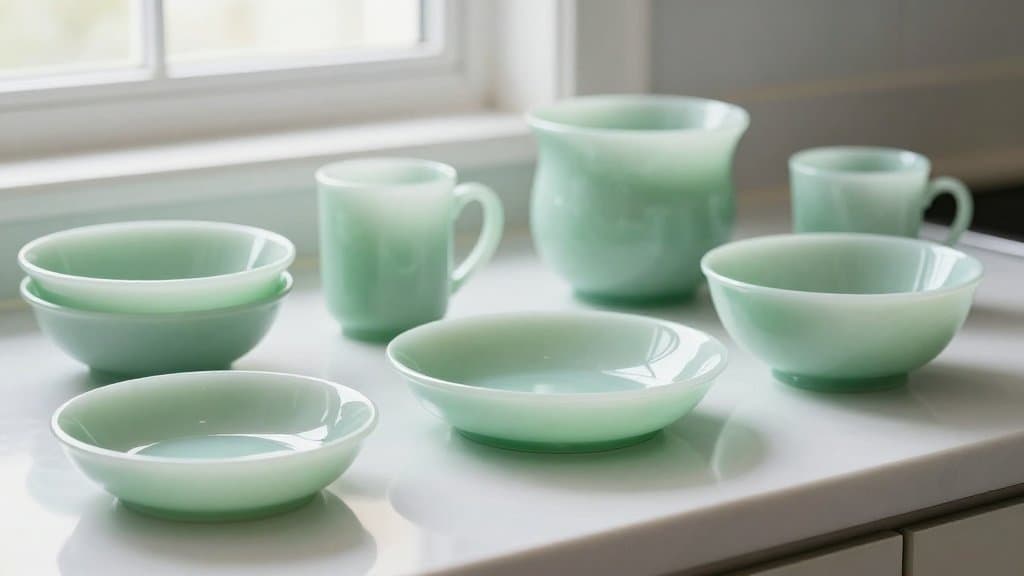
That soft green glass on the bottom shelf at Goodwill is one of the best flips hiding in plain sight. Collectors chase Fire King jadeite, and one mug or bowl can turn a dollar into real money. Here's the catch. Jadeite value swings from a few bucks to well past a thousand, so you want to know what you're holding before you pay.
The good news is that jadeite hides its age in places you can actually check. The mark on the base, the exact shade of green, the weight in your hand, and how the glass reacts under a blacklight all tell you whether it's a 1950s original or a modern copy. Learn those signals and you'll judge jadeite value on the spot instead of guessing.
Where jadeite came from
Anchor Hocking made most of its jadeite between 1945 and 1975 at its factory in Lancaster, Ohio. The color came from iron and other oxides mixed into opaque glass, which gave that creamy jade tone people love. The company even used its own spelling, Jade-ite, while rivals McKee and Jeannette went with Jadeite and Jadite.
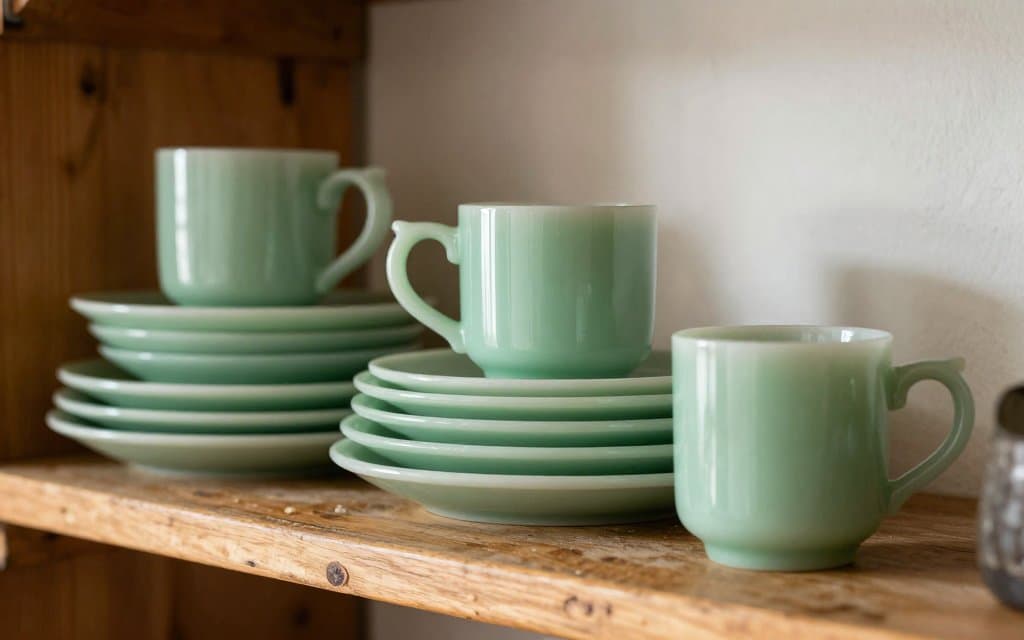
Jadeite is really a tinted vintage Fire King milk glass, cheap and sturdy oven glass that families used hard. The Fire-King brand name first showed up in 1942 on the Philbe ovenware line, and the color soon spread across dinnerware, mixing bowls, mugs, and restaurant pieces. That heavy daily use is exactly why clean examples are worth chasing now.
Anchor Hocking poured out jade green glass for thirty years, so plenty survives. The clean, early pieces are the ones that actually pay.
How to identify jadeite from the marks
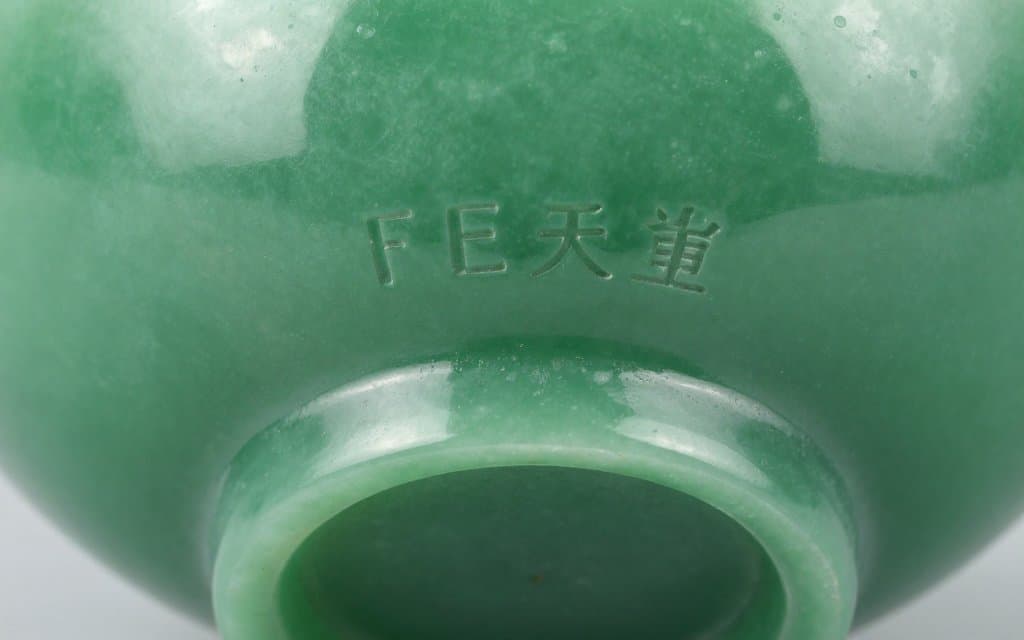
Flip the piece over first. Most real Fire King jadeite carries a molded backstamp that reads OVEN Fire-King WARE MADE IN U.S.A., sometimes shortened to Fire-King OVEN WARE. The lettering sits down in the glass, a little soft and uneven, never crisp and printed on top.
Older marks matter for money. Block style letters from the 1940s usually beat the busier stamps from the 1960s and 1970s, and that gap can be worth hundreds on the same shape. A few lines, like the Alice and Charm patterns, shipped with no mark at all or just a gold foil sticker, so a blank base is not proof of a fake.
- •Read the base for an Oven Fire-King Ware stamp
- •Feel for heavy glass with soft molded letters
- •Look for even jade color, not a painted-on tint
- •Check rims and handles for value-killing chips
- •Note a foil sticker or old box as a price bonus
The blacklight test that ends the argument
Keep a small UV blacklight in your bag, because this one test sorts the makers fast. Real McKee and Jeannette jadeite glow bright green under UV because the old glass contains uranium, the same thing that makes uranium glass light up. Anchor Hocking Fire-King glass does not glow at all.
So a green piece that lights up is not Fire-King, though it can still bring good money as McKee or Jeannette. A piece that stays dark, wears the right stamp, and shows honest use is your Anchor Hocking jadeite. It's a thirty second check that saves you from an expensive mistake.
Fire King jadeite never glows under a blacklight. If your green glass lights up, you're holding Jeannette or McKee, not Anchor Hocking.
What drives Fire King jadeite value
Four things move Fire King jadeite value more than anything else. Pattern rarity comes first, then condition, then the age of the mark, then whether the original packaging survived. Common lines like Jane Ray and Restaurant Ware turn up often, so they sit lower, while short-run patterns and odd shapes climb quickly.
Condition is brutal on glass. A hairline crack, a chip on the rim, or heavy utensil scratches can cut a price in half. Pristine jadeite dishes, especially ones that still wear the original foil sticker, pull the strongest numbers because so few survived a real kitchen.
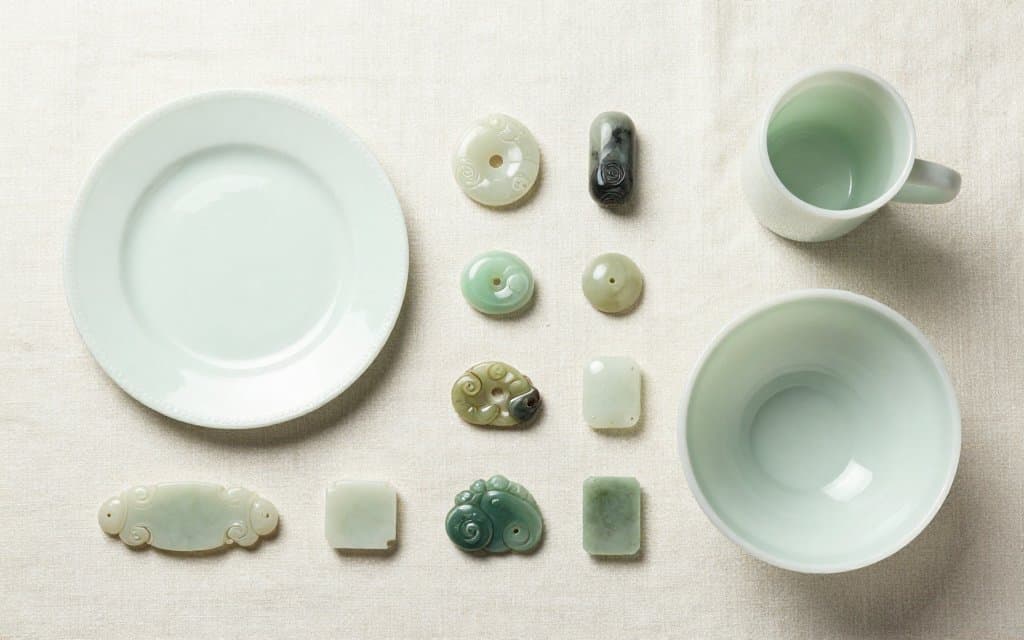
A block letter mark from the 1940s can beat a busy later stamp by hundreds of dollars on the very same bowl.
Real jadeite dishes versus reproductions
Reproductions are everywhere, and some are honest tributes rather than fakes. In 2000, Anchor Hocking made a run clearly marked Anchor Hocking Fire-King 2000 on the base, so that stamp is a friend, not a trap. Newer jadeite dinnerware from Mosser, Martha Stewart, Pioneer Woman, and others is sold new and isn't trying to fool anyone.
The trouble starts when a modern piece loses its sticker and lands in a vintage bin. Real vintage Fire King dishes show dullness, tiny paint chips, and light scratches from decades of dinners. Watch for lettering that looks too perfect and a base with zero wear, since those are your loudest warnings that a piece was born yesterday.
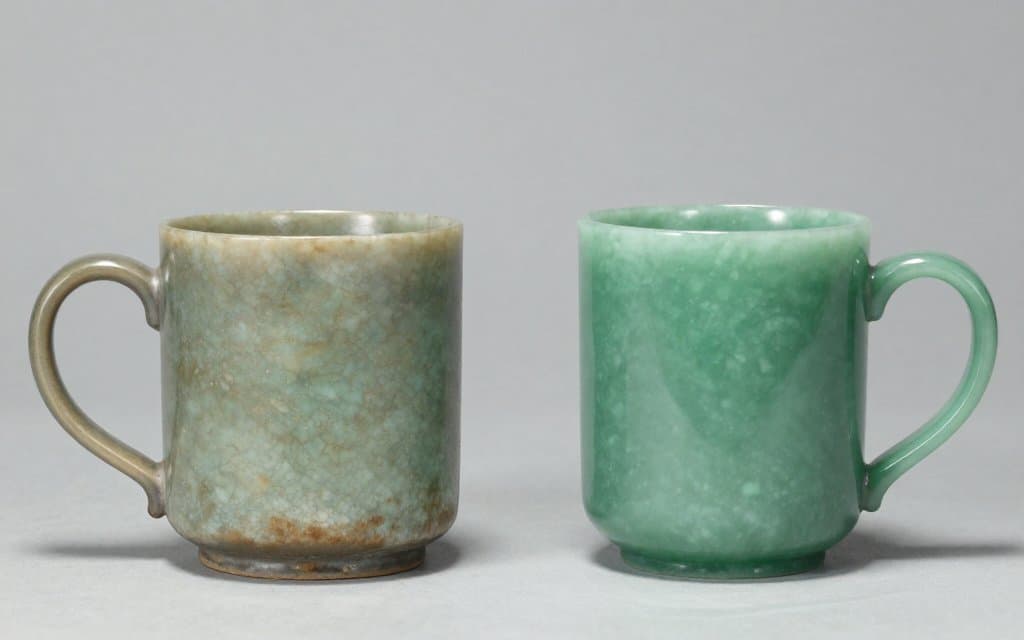
- •Bright, flawless lettering with no softness
- •A base with no wear, haze, or utensil marks
- •Color that looks neon instead of soft jade
- •An Anchor Hocking Fire-King 2000 backstamp
- •A price that seems too cheap for the shape
What jadeite dishes sell for right now
So what does the money actually look like? Everyday jadeite runs cheap, and a common Jade-ite Laurel cup trades around 35 dollars. From there it climbs fast, and collector jadeite price guides put boxed Jane Ray and Philbe sets from the 1940s and 1950s at 400 to 500 dollars, with a rare Philbe pie plate or mug passing 500 on its own.
At the top, a Fire King serving dish in a scarce shape, like a Restaurant Ware gravy boat, can clear a thousand dollars, and museum grade rarities sit above 5,000. Even the 2000 reissue casseroles hold 60 to 150 dollars, which shows how strong demand for solid jadeite price data has become.
| Piece | Era or mark | Value |
|---|---|---|
| Jade-ite Laurel cup | Common pattern | $35 |
| Jane Ray boxed set | 1940s to 1950s | $400 to $500 |
| Philbe pie plate | Block letter mark | $500 plus |
| Restaurant Ware gravy boat | Commercial line | $1,000 plus |
| 2000 reissue casserole | Fire-King 2000 mark | $60 to $150 |
Jadeite sits in the same hot corner of the market as vintage Pyrex and Blue Cornflower CorningWare, where the right pattern turns a shelf find into a payday. The difference is the color. Nothing else on the thrift shelf glows that particular jade.
- •Jane Ray, the rayed border retail line
- •Restaurant Ware, heavy and built for diners
- •Alice and Charm, often unmarked pieces
- •Philbe, an early and pricey ovenware line
- •Swirl and Sheaves of Wheat, rare and prized
Jadeite questions thrifters ask
How can I tell real jadeite from a reproduction?
Start with the base and a blacklight. A genuine piece shows a soft molded Fire-King mark, honest wear, and no glow under UV. If the glass lights up green, it's McKee or Jeannette, and if it reads Anchor Hocking Fire-King 2000, it's the newer tribute run rather than a 1950s original.
Does all jadeite glow under a blacklight?
No, and that surprises people. McKee and Jeannette jadite contain uranium and glow, but Anchor Hocking Fire King jadeite stays dark. So the glow test tells you the maker, not simply whether a piece is old.
Which jadeite pieces are worth the most money?
Rare shapes in early patterns lead the pack. Philbe pie plates and mugs pass 500 dollars, Restaurant Ware gravy boats can clear a thousand, and true museum pieces sit far higher. Common Jane Ray cups and saucers stay affordable, often under 20 dollars.
Where do I find jadeite while thrifting?
Check kitchenware shelves, glass display cases, and boxed lots at estate sales. Coffee mugs and mixing bowls show up most, while dinner plates and serving pieces are the ones that pay. A quick phone scan settles the value before you commit.
Stop guessing at the thrift store and let the app do the math. Thrift Scanner reads the piece in front of you, checks real sold prices, and tells you what jadeite is worth before you buy. Snap a photo, see the numbers, and never leave money on the shelf again. Get the app here: iOS or Android.